 Anguilla
 Antigua and Barbuda
 Grenada
 Bahamas
 Barbados
 Belize
 Dominica
 Guyana
 Haiti
 Jamaica
 Montserrat
 St. Kitts and Nevis
 St. Lucia
 St. Vincent and the Grenadines
 Suriname
 Trinidad and Tobago
 Turks and Caicos
 Documents Management Reports Jobs and Consultancies STAR-FISH Project Implementation Plan and First Year Annual Work Plan
Stakeholders engage to translate Belize’s sustainable ocean priorities into coordinated action
Belize City, Belize, Tuesday, 20 October 2026 (CRFM)—Stakeholders from across Belize’s governance, regulatory and ocean management landscape are meeting in Belize City for the Belize Sustainable Ocean Plan (BSOP) Implementation and Monitoring Plan Validation and Co-Design Workshop, an important step towards translating the country’s sustainable ocean priorities into practical, coordinated and implementable actions.

Representatives of key government ministries, departments, and regulatory agencies are among the stakeholders attending the two-day BSOP workshop.
Photo: BE-CLME+ Project
The workshop is being led by the Coastal Zone Management Authority and Institute (CZMAI) with support from the BE CLME+ Project and over the next 2 days, brings together representatives of key government ministries, departments, regulatory agencies and other stakeholders that have responsibilities for, or will be affected by, implementation of the BSOP.
The workshop moves beyond consultation to focus on validation, feasibility testing and co-design. Participants are critically reviewing the proposed implementation and monitoring arrangements to determine what will be required to translate the BSOP’s strategic priorities into coordinated action.
Through facilitated discussions and working sessions, stakeholders are examining the feasibility of proposed actions and generating clear recommendations and decisions on:
- priority actions for implementation;
- the roles and responsibilities of relevant government and regulatory agencies;
- institutional and inter-agency coordination arrangements;
- environmental, social and other relevant safeguards;
- human, technical and financial resource requirements;
- practical considerations that could enable or constrain implementation; and
- arrangements for monitoring progress and supporting accountability.

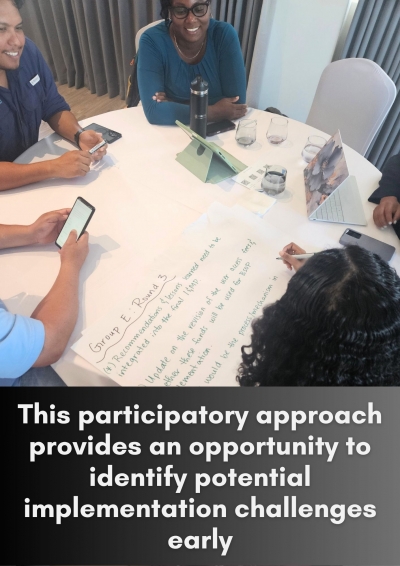
Attendees brainstorm to strengthen implementation and monitoring.
Photo: BE-CLME+ Project
A key focus of the workshop is ensuring that the proposed Implementation and Monitoring Plan reflects the realities of the agencies and stakeholders that will ultimately be responsible for delivering the BSOP. This participatory approach provides an opportunity to identify potential implementation challenges early, clarify institutional responsibilities and strengthen ownership of the actions proposed.
The BE CLME+ Project’s support for the initiative contributes to wider efforts to strengthen sustainable Blue Economy development and integrated ocean governance across participating Caribbean countries. In Belize, this support is helping to strengthen the enabling conditions needed to put national ocean priorities into practice.
The Caribbean's Blue Economy Knowledge now has a new home

BE-CLME+ Knowledge Management Platform aims to connect policymakers, fisherfolk, private sector, and communities
Belize City, Belize (CRFM) – The Caribbean Regional Fisheries Mechanism (CRFM), in partnership with the Food and Agriculture Organization of the United Nations (FAO), and the Development Bank of Latin America and the Caribbean (CAF), have officially launched an open-access, Caribbean Blue Economy (BE) Knowledge Hub that brings together decades of the region’s expertise and insight on fisheries, aquaculture, and marine spatial planning.

The knowledge hub is a permanent, multilingual home for Blue Economy data, best practices, policy tools, and technical insight from across the participating countries–Barbados, Belize, Guyana, Jamaica, Panama, and Saint Lucia—built on CRFM’s expertise and the knowledge generated through the BE-CLME+ Project.
The digital platform is a crucial outcome of the Global Environment Facility (GEF)-funded, BE-CLME+: Promoting National Blue Economy Priorities Through Marine Spatial Planning in the Caribbean Large Marine Ecosystem Plus project.
Dr. Marc Williams, Executive Director, CRFM, stated, “The BE-CLME+ Knowledge Management Hub represents the continued drive of the CRFM to make knowledge products more accessible to all stakeholders; connecting policymakers, practitioners, researchers, and communities to the evidence they need to act, adapt, and lead.”
Dr. Williams further elaborated: “Small-scale fishers, women who process and trade the catch, youth deciding whether this industry has a future worth joining, and Indigenous communities whose stewardship of marine ecosystems spans generations — all will find, in this platform, a resource calibrated to their realities. That means accessible formats, multilingual content, and practical tools that translate regional expertise into actionable guidance for every practitioner in the value chain, including fisherfolk, academics, and policymakers alike.”
Powered by insights produced through the BE-CLME+ Project and CRFM, the Hub organises technical reports, policy briefs, fact sheets, and multimedia resources across seven thematic areas for easy discovery. Users can search, filter by theme, and access an AI-powered assistant — “Ask BE-CLME” — available in both English and Spanish to help navigate the platform's resources.
Across the six participating countries, governments now have a consolidated evidence base—which can be found at www.beknowledge.crfm.int—to drive marine spatial planning, sharpen national fisheries policy, and attract blue economy investment.

Dr. Renata Clarke, FAO Sub-Regional Coordinator for the Caribbean, said, “The importance of this platform cannot be overstated. It would help to unlock grey literature to better support decision-making by practitioners that is centered on benefits to communities. At present, piles of information and knowledge produced over decades sit unused, on desks and in drawers of national officers.”
With “over USD 200 million in annual Caribbean exports and more than half-a-million jobs” at stake across coastal communities from Belize to Barbados, according to the CRFM Statistics and Information Report – 2021/2022, the sustainable management of marine resources is an economic and food security imperative.
 Erick Castro, Principal Executive, CAF, said, “
Advancing a sustainable blue economy requires long-term investment in knowledge, governance, and human capital. Through BE-CLME+, we are helping to build the foundations that enable countries to make informed decisions, strengthen institutions, and unlock opportunities for inclusive and resilient growth. This platform is a tangible example of that commitment, transforming regional knowledge into a shared asset that will continue to generate blue value over time.
”
Sustainability Is Not a Cost — It Is the Business Case
The Caribbean sits at the centre of one of the most biodiverse marine regions on earth, yet a significant share of its seafood continues to be exported as raw, unprocessed product which leaves most of the value, and most of the jobs, somewhere else. Closing that gap is a trade strategy, not a conservation ambition.
The BE-CLME+ Knowledge Management Platform provides the market frameworks, training, and certification pathways for seafood standards, and value chain intelligence that make sustainable seafood profitable, scalable, and investable; while equipping businesses with the regional data they need to make decisions with confidence.
Since 2023, the BE-CLME+ project has aimed to maintain and preserve cultural heritage through sustainable fisheries management, improved livelihoods, and alternative livelihoods while strengthening the integration of fisheries and ecosystem management to restore, protect, and maintain marine biodiversity, productivity, and resilience of marine ecosystems.
###
Peter A. Murray is the new Regional Project Coordinator for the BE-CLME+ Project


The CRFM Secretariat is pleased to announce that Mr. Peter A. Murray is the new Regional Project Coordinator of the USD 48 million GEF/CAF/FAO/CRFM Project entitled, “Promoting National Blue Economy Priorities Through Marine Spatial Planning in the Caribbean Large Marine Ecosystem Plus Region" (BE-CLME + Project).
Mr. Murray formerly served as the CRFM's Advisor, Fisheries Management and Development, and he has played an active technical role for several decades on BE-related matters across the Caribbean, in addition to monitoring control and surveillance, illegal unreported and unregulated fishing and the broader spectrum of trans-national crime, gender, and fisheries nutrition, health and sanitary issues.
He comes highly qualified with 45 years of experience in fisheries as well as a Master of Philosophy degree in Biology and a Diploma in International Environmental Law. He has been senior-most Fisheries Biologist at Saint Lucia’s Department of Fisheries; senior Programme Officer at the OECS Secretariat, and Programme Manager at the Caribbean Regional Fisheries Mechanism Secretariat.
Mr. Murray, who succeeds Dr. Dayne Buddo, now has lead responsibility for overseeing BE-CLME+ project activities. As such, he will work towards ensuring alignment with strategic goals, timely delivery of planned activities and fostering collaboration among stakeholders and partners. His extensive experience and knowledge will be very helpful in advancing the objectives of the project, which is focused on marine spatial planning, marine managed areas, seafood value chain development, and ultimately the sustainable use and management of marine living resources, biodiversity conservation, stakeholder engagement and capacity-building throughout the region, and enhancing resilience to climate change and ocean acidification.
The CRFM welcomes Mr. Murray to his new role and wishes him all the best in this new chapter of his professional journey.
World Oceans Day Remarks from CRFM Executive Director, Dr. Marc Williams


Today, as we observe World Oceans Day, we are reminded that the Caribbean Sea and our surrounding oceans are not only a source of natural beauty but also the foundation of livelihoods, culture, food security, and economic opportunity for millions of people across our region. The theme of ocean stewardship has never been more important. For the Caribbean, the future of our oceans is inseparable from the future of our people. Healthy marine ecosystems support fisheries, tourism, transportation, coastal protection, and countless other services that sustain our economies and communities. As we celebrate this day, we must reaffirm our collective commitment to safeguarding our marine resources for present and future generations.
Small-scale fisheries remain the backbone of the fisheries sector in most Caribbean countries. Thousands of fishers, fish vendors, processors, and their families depend directly on the sea for their livelihoods and well-being. These fisheries contribute significantly to local food supplies, employment, poverty reduction, and cultural heritage. As global food systems face mounting pressures from climate change, economic uncertainty, and supply chain disruptions, investing in sustainable small-scale fisheries is essential to strengthening regional food and nutrition security. We must continue to empower fishing communities through improved management, access to finance, modern technology, capacity building, and policies that recognize their invaluable contributions to national and regional development.
At the same time, the Caribbean has tremendous opportunities to expand sustainable mariculture and aquaculture as part of a diversified Blue Economy. Responsible mariculture can increase domestic seafood production, reduce reliance on imports, create jobs, attract investment, and build resilience to climate-related shocks. Through innovation, science-based planning, and effective marine spatial management, we can unlock new opportunities in marine fish farming, seaweed cultivation, shellfish production, and other ocean-based industries while safeguarding marine biodiversity. The CRFM remains committed to supporting Member States in advancing sustainable Blue Economy initiatives that balance economic growth, environmental stewardship, and social inclusion.
However, the promise of our oceans cannot be realized if marine pollution continues to endanger our ecosystems. Plastic waste, abandoned fishing gear, land-based runoff, wastewater discharge, and other pollutants are degrading coastal habitats, damaging coral reefs, threatening marine life, and undermining fisheries productivity. Addressing marine pollution requires action by governments, businesses, communities, and individuals alike. On this World Ocean Day 2026, let us renew our commitment to reducing pollution at its source, strengthening waste management systems, promoting sustainable consumption, and protecting the marine environment on which our prosperity depends. Together, we can build a cleaner, healthier, and more resilient Caribbean Sea that continues to nourish our people, support our economies, and inspire future generations.
STAR-Fish


|
WHAT IS STAR-FISH AND WHY IT MATTERS |
||
| Fisheries across the Caribbean are highly dependent on fossil fuels, making them vulnerable to rising energy costs and climate risks. STAR-Fish seeks to demonstrate that: | ||
 Renewable energy reduces operational costsEnergy-efficient technologies improve productivityInclusive approaches strengthen long-term resilience |

|
PROJECT FOCUS AREAS |


|
PROJECT PROFILE |
||
|
Sustainable Technologies for Adaptation and Resilience in Fisheries - STAR-Fish Donor-funded by Global Affairs Canada |
||
|
The STAR-Fish Project seeks to demonstrate that energy costs can be substantially reduced by transitioning to renewable energy technologies. The project intends to ultimately increase clean energy transition in Caribbean fisheries and aquaculture by applying a gender-responsive approach to its interventions, as it supports the certification of low carbon or carbon neutral fisheries in the region and facilitates technical collaboration and knowledge exchange. The STAR-Fish Project is pivotal for the advancement of the CRFM’s 2022-2030 Strategic Plan. It particularly supports the attainment of Strategic Goal 4 (Section 4.1c), which envisions “Increased use of renewable energy and energy efficient harvesting, processing, and cold storage systems, and reduction of the region’s reliance on fossil fuels in fisheries and aquaculture.” The overall objective of STAR-fish is to enhance sustainable economic growth through building (or improving) resiliency of the Caribbean fisheries sector |


|
PROJECT COUNTRIES |
|
OUR TEAM |

CONTENT AND RESOURCES

CRFM Ministerial Council addresses fisheries, aquaculture, and blue economy priorities at 20th Regular Meeting

Belize City, Belize, 3 June 2026 (CRFM)—The Ministerial Council of the Caribbean Regional Fisheries Mechanism (CRFM), a regional inter-governmental body of the Caribbean Community (CARICOM), convened its Twentieth (20th) Regular Meeting today. The Council, comprised of Fisheries, Aquaculture, and Blue Economy Ministers from the Caribbean, deliberated via teleconference on key issues confronting the sector. These include bolstering aquaculture development, improving food security, strengthening resilience to climate and disaster risks through insurance, and notable gains in addressing illegal, unreported, and unregulated (IUU) fishing.
Before delving into these pressing matters, the Council elected Hon. Randy Baltimore, Minister of State in the Ministry of Agriculture, Lands, Fisheries and the Blue Economy, Antigua and Barbuda, as Chair. Minister Baltimore succeeds Hon. Kyle Hodge, Minister of Economic Development, Industry, Commerce, Lands, Planning, Water, and Natural Resources, Anguilla, who rendered stellar service as Chair of the CRFM Ministerial Council during the previous year.
In accepting the Chairmanship, Antigua and Barbuda reaffirmed its commitment to strengthening regional cooperation, promoting sustainable use of marine resources, supporting fisherfolk livelihoods, and advancing innovative solutions to challenges facing the fisheries sector, including climate change, illegal fishing, and marine resource management.
Minister Baltimore said: “The Government of Antigua and Barbuda looks forward to working closely with CRFM Member States and regional partners to further the sustainable development of the Caribbean’s fisheries and blue economy sectors during its tenure as Chair.”
He noted that he had recently been assigned to the portfolio following national elections in the Member State. Supported by the Chair of the Caribbean Fisheries Forum, Mr. Ian Horsford, Chief Fisheries Officer, Antigua and Barbuda, the Ministers effectively addressed a range of topics, resulting in the passage of 19 resolutions critical to the advancement of the fisheries and aquaculture sector.

Minister Baltimore chairing the Council meeting from Antigua and Barbuda (Photo: Government of Antigua and Barbuda)
In addressing the Council at the conclusion of the meeting, CRFM Executive Director, Dr. Marc Williams said: “The Caribbean stands at a pivotal moment when sustainable fisheries, aquaculture, the Blue Economy, climate resilience, and ocean governance must be integrated to secure prosperity for present and future generations. I encourage all Member States to maintain their strong engagement in implementing today's resolutions and to continue supporting the CRFM as a premier regional institution for fisheries and ocean governance.”
The Ministers approved a new 5-year aquaculture action plan, as well as a new biennial work plan and budget for the CRFM, spanning 2026-2027. They also received updates on three regional initiatives through which critical work is being undertaken by the CRFM, in collaboration with its Member States and institutional partners, to strengthen the sector. These are the Canadian-funded Sustainable Technologies for Adaptation and Resilience in Fisheries (STAR-fish) Project, the IICA/EDF-EU Food Security Project, as well as the GEF/FAO/CAF/CRFM BE-CLME+ Project: Promoting National Blue Economy Priorities Through Marine Spatial Planning in the Caribbean Large Marine Ecosystem Plus.
“The Council’s decisions on the CRFM work plan and budget, financial management, staffing, and strategic priorities provide a strong foundation for advancing the CRFM’s goals and delivering tangible benefits to the people who depend on our marine resources,” Dr. Williams said.
The Council is scheduled to meet again later this year, during the 20th Caribbean Week of Agriculture in Jamaica.
###
Promoting a Fishery-Centered Blue Economy Through Co-Benefits and Knowledge Sharing
Promoting a Fishery-Centered Blue Economy Through Co-Benefits and Knowledge Sharing
Nariaki Mikuni*1, Saori Imamura*2, Rita Straughn Mitchel*3 and Hiroaki Terashima*2
JICA project for Forming Good Practices of Islands-type Blue Economy in Palau,
Former project member of CARIFICO*1
P.O. Box 359 Koror, Palau 96940
E-mail: This email address is being protected from spambots. You need JavaScript enabled to view it.
IC Net Limited. Member for the Project for Strengthening Sustainable Use
and Management of Coastal Fisheries Resources in the CARICOM Countries (COASTFISH)*2
LA Tower 27 F., 11-2 Shintoshin, Chuo-ku, Saitama-shi, 3306027, Japan.
E-mail: This email address is being protected from spambots. You need JavaScript enabled to view it.
; This email address is being protected from spambots. You need JavaScript enabled to view it.
Department of Fisheries, Saint Lucia*3
Pointe Seraphine Castries Saint Lucia
E-mail: This email address is being protected from spambots. You need JavaScript enabled to view it.
ABSTRACT
 The Caribbean region is currently witnessing a diverse range of projects aimed at promoting the blue economy. The Japan International Cooperation Agency (JICA) is formulating a strategy that recognizes co-benefits and knowledge sharing as fundamental drivers for advancing the blue economy. This strategy encompasses several stages: viz. 1. Development of concrete examples through pilot activities; 2. Extraction of knowledge from these examples (including good practices and lessons learned) and accumulation in a comprehensive database or toolbox; 3. Implementation of seminars and workshops to facilitate knowledge sharing and the formation of a multilateral cooperation framework or platform involving governments, donors, international organizations, and public-private-academic sectors; and 4. Development of an international strategy or initiative to promote the blue economy and the establishment of a positive cycle that enhances the priority of pilot activities in national development plans, increases budget allocation and donor funding, and implements additional pilot activities based on the initiative. These components draw upon Japan's extensive experience in co-benefits, such as fisheries resource co-management, food value chains, and the concept of satoumi, which seeks to enhance production and biodiversity through harmonious human-nature interaction. Furthermore, the strategy incorporates effective mechanisms for knowledge sharing, including the utilization of an online knowledge database or toolbox specifically focused on small-scale coastal fisheries, as well as national public presentation events featuring representatives from successful fishermen groups. In this context, JICA has been actively implementing pilot projects in the Caribbean, including the co-management of Fish Aggregating Devices (FADs), the integration of food value chains with tourism sector through processing seafood products and diver-driven lionfish eradication as well as the satoumi approach through utilizing seaweed cultivation. In future, collaborative efforts with the Caribbean Regional Fisheries Mechanism (CRFM), governments, and donors, including JICA, are expected to facilitate knowledge sharing, formulation, and accumulation of further examples, effectively promoting the blue economy.

HOW TO CITE: Mikuni, N., S. Imamura, R. Straughn Mitchel and H. Terashima, 2026. Promoting a Fishery-Centered Blue Economy Through Co-Benefits and Knowledge Sharing. Contribution 9.1, p606-617 IN CRFM, 2026. Volume I: Technical Papers. Presented at the CRFM 20th Anniversary Scientific Conference, 28-31 August 2023. CRFM Special Publication No. 37, CRFM Secretariat https://www.crfm.int/index.php?option=com_k2&view=item&id=952
POWERPOINT

VIDEO PRESENTATION

FULL SCIENTIFIC PUBLICATION


Download CRFM Special Publication No. 37:
Proceedings of the CRFM 20th Anniversary Scientific Conference
KEY LINKS
Scientific Conference Home Page
Scientific Conference Proceedings Page
Explore all 20th Anniversary Scientific Papers
NOTE
If you have challenges accessing or downloading documents in this series, please email us at This email address is being protected from spambots. You need JavaScript enabled to view it. , copied to This email address is being protected from spambots. You need JavaScript enabled to view it. , or call us at +501-223-4443. Some browsers do not properly load Google Drive documents, so if you have challenges accessing the PowerPoint slides or the full special publication, try switching to another browser such as Google Chrome or Microsoft Edge.
New CRFM Programme Manager, Ms. Sanya Compton, delivers opening remarks at the Blue Justice Conference 2025

The Caribbean Regional Fisheries Mechanism (CRFM) Secretariat’s new Programme Manager – Climate Change & Blue Economy Development Policy, Planning, and Management, Ms. Sanya Compton, delivered opening remarks on behalf of the CRFM at the Blue Justice Conference 2025, on Tuesday, 2 December, in UN City, Copenhagen.
She addressed two key issues at the heart of the conference theme: “United in Action against Fisheries Crimes.” These are transnational organised crime in the fishing industry, including illegal, unreported and unregulated (IUU) fishing; as well as the need for strong partnerships to strengthen responsible, sustainable management of our fisheries and other ocean assets.
In her remarks, Ms. Compton flagged four (4) perils of IUU fishing:
- It undermines the foundation of sustainable fisheries management;
- It erodes confidence in legal frameworks;
- It destabilizes regional markets; and
- It threatens the long-term viability of target species.
She urged stakeholders to strengthen their resolve and partnerships, and reaffirm their commitment to safeguarding the marine resources that provide food security, livelihoods, resilience, and rich cultural value.
She underlined the vital importance of strong strategic partnerships for addressing the challenges of IUU fishing and fisheries-related crimes and to responsibly manage our fisheries, our oceans, and all aspects of our Blue Economy.

Mr. Virun Lutchman, Environmental Crime Lead, Caribbean Community Implementation Agency for Crime and Security (CARICOM IMPACS), Blue Justice Caribbean Hub, presented on data and digital technology in addressing fisheries crime.
Three CRFM Member States offered their country insights. Ms. Wynnona Joseph, Senior Fisheries Officer, Ministry of Agriculture, Fisheries, Blue and Green Economy, presented for the Commonwealth of Dominica; H.E. Noersalim Mike Mohamed Faizel, Minister of Agriculture, Animal Husbandry and Fisheries, presented via digital recording for Suriname; and H.E. Floyd O’Brian Green, Minister of Agriculture, Fisheries and Mining, delivered a live digital presentation for Jamaica.

Jamaica also participated in a discussion on regional cooperation. H.E. Green, and Dr. Gavin Bellamy, Chief Executive Officer of the National Fisheries Authority, Jamaica, shared their experiences with hosting and administrating the Blue Justice Caribbean Hub - the first of its kind under the Blue Justice Initiative.

Prior to traveling to Copenhagen, Ms. Compton had attended a Global Affairs Canada (GAC) Results-Based Management (RBM) Training–a three-day event held in Jamaica–with CRFM's Sherron Barker, Regional Project Coordinator of the Global Affairs Canada/CRFM STAR-Fish Project. The training provided insights into GACs RBM concepts and tools, allowing participants to explore RBM methodology and practice to improve project management, decision-making and reporting. The training also addressed the conceptualization of and process for the development of logic models and theory of change.
Ms. Compton was appointed in September 2025 to take up a newly created post within the CRFM Secretariat–Programme Manager – Climate Change & Blue Economy Development Policy, Planning, and Management–in line with the CRFM’s strategic direction for the period 2022-2030.
Some specific elements covered under her portfolio are:
Policy and Programme Development and Implementation: Lead the planning and development of policies, implementation and monitoring of programs and projects addressing climate change impacts, adaptation and mitigation, and blue economy development focused on the marine living resources.
Blue Economic Development: Design and implement blue economy programs that enhance sustainable fisheries, aquaculture, marine tourism, and ocean-based livelihoods; identify investment opportunities and partnerships for the blue economy within the Caribbean region; promote gender-inclusive and socially equitable approaches to blue economic development.
Capacity-Building and Stakeholder Engagement: Support institutional and analytical capacity building on policy analysis, formulation, and implementation for sustainable management of fisheries, climate change adaptation, blue economic and aquaculture development.
Ms. Compton–who holds over 15 years of experience in the sector and a Master of Science Degree in Marine Science from Savannah State University in Georgia, USA–has been working with the CRFM Secretariat since May 2023. She started out providing consultancy services to support the portfolio for Fisheries Management and Development. After completing that consultancy, she was hired as Research Graduate, Research and Resource Assessment and retained that role until her recent Programme Manager appointment.
Event photos courtesy Peter A. Murray, CRFM Advisor, Fisheries Management and Development.
Fisheries and Aquaculture in the spotlight at high-level and technical events during CWA 2025

Basseterre, Saint Kitts and Nevis, 29 September 2025 (CRFM)—The Caribbean Regional Fisheries Mechanism (CRFM) is convening three hybrid events spotlighting the fisheries and aquaculture sector, this week during the 19th Caribbean Week of Agriculture. The annual event, held under the auspices of the Caribbean Community (CARICOM) Secretariat, opened at the St. Kitts Marriott Resort on Monday, 29 September 2025.

Hon. Samal Duggins, host Minister for CWA 2025 and the upcoming 16th Special Meeting of the CRFM Ministerial Council, addressing the audience at the opening of CWA 2025 in Saint Kitts and Nevis
Host Minister for the weeklong event, Honourable Samal Duggins, Minister of Agriculture, Fisheries, and Marine Resources, said in his remarks: “Our region has not always given agriculture the priority it deserves. Too often, it has been seen as a sector of last resort, rather than being recognized as a pillar of sovereignty and a pillar of growth. For too long, our farmers and our fishers—the true heroes of food security—have carried the heaviest of these burdens with too little recognition and too little support.”
He added that, “This week must be remembered as the moment when we moved from words to deeds, the moment we moved from intentions into deliberate actions… Let us leave with commitments rooted in the soil, reflected in our oceans, and lived in the homes of our people.”
On Tuesday, September 30, 2025, Minister Duggins will host the 16th Special Meeting of the CRFM Ministerial Council, which will be chaired by Honourable Kyle Hodge, Anguilla’s Minister of Economic Development, Industry, Commerce, Lands, Planning, Water, and Natural Resources.

Chair of the CRFM Ministerial Council, Honourable Kyle Hodge of Anguilla (right), with Undersecretary in the Ministry of Agriculture & Marine Resources, The Bahamas, Mr. Montez Williams
The agenda of the CRFM Ministerial Council focuses on items such as the status and trends in fisheries and aquaculture production, trade, and employment; initiatives to combat illegal, unreported, and unregulated (IUU) fishing; a new grievance redress mechanism for the CRFM; a regional training and capacity needs assessment being undertaken by the CRFM with support from GRÓ-Fisheries Training Programme (FTP), under the auspices of the United Nations Educational, Scientific and Cultural Organization (UNESCO), as well as south-south cooperation with China.
The Ministers will also receive updates and provide policy guidance on regional initiatives to address climate resilience and blue economic growth. These include the Global Affairs Canada-funded Sustainable Technologies for Adaptation and Resilience in Fisheries (STAR-Fish) Project; the GEF/CAF/FAO/CRFM BE-CLME+ Project: Promoting National Blue Economy Priorities through Marine Spatial Planning in the Caribbean Large Marine Ecosystem Plus (BE-CLME+); and the New Zealand Bioeconomy Science Institute: Plant and Food Research Group/CRFM Sargassum Products for Climate Resilience in the Caribbean Project.
Also on Tuesday, September 30, starting at 1:00 p.m. in the Saint Kitts (Plenary) Room at the Marriott, the Ministers will be invited to join stakeholders and partners, in person and online, at the final event being implemented under the Sargassum Products for Climate Resilience in the Caribbean Project: the Sargassum Seminar titled, From Sargassum to Biostimulant: Sowing Change and Harvesting Resilience.
Then on Wednesday, October 1, starting at 1:30 p.m. in the Dominica Room, the CRFM will partner with the Department of Marine Resources and the National Fisherfolk Organization of Saint Kitts and Nevis to convene the Caribbean Small-scale Fisheries & Aquaculture Forum.
Both technical events—the seminar and forum—will be held in hybrid format, and interested persons can either attend in person or online. Registration is still open via the CRFM’s website (crfm.int).
Finally, the CRFM, through the Canada-funded STAR-Fish project, will mount a renewable energy exhibit at the 30th Agri Open Day & Marine Expo to be held at the Royal Basseterre Valley National Park, Kim Collins Highway, on Thursday, October 2 and Friday, October 2, 2025.
– END –
(Photos and video footage courtesy Ministry of Agriculture, Fisheries and Marine Resources, Saint Kitts and Nevis)
Request for Proposal - REGIONAL CONSULTANCY TO IDENTIFY VALUE CHAIN CAPACITY NEEDS AND GAPS

REGIONAL CONSULTANCY TO IDENTIFY VALUE CHAIN CAPACITY NEEDS AND GAPS
| DATE: | 4 August 2025 |
| TITLE: | REGIONAL CONSULTANCY TO IDENTIFY VALUE CHAIN CAPACITY NEEDS AND GAPS |
| CATEGORY: | Consultancy |
| PROJECT/ORGANIZATION: | CRFM |
| DEADLINE EXTENDED | 5 September 2025 (See Amendment No. 1) |
| REQUEST FOR PROPOSALS: | CLICK HERE |
| TERMS OF REFERENCE: | CLICK HERE |
| STATUS: | Open |