Anguilla
  Antigua and Barbuda
  Grenada
  Bahamas
  Barbados
  Belize
  Dominica
  Guyana
  Haiti
Haiti  Jamaica
  Montserrat
  St. Kitts and Nevis
  St. Lucia
  St. Vincent and the Grenadines
  Suriname
  Trinidad and Tobago
  Turks and Caicos

An Assessment of the Reproductive Activity of Queen Conch (Aliger gigas) in Captive and Wild Populations in the Discovery Bay Special Fishery Conservation Area, Jamaica
Shanna- Lee Thomas1, Camilo Trench1, Dale Webber2, and Mona Webber3
Discovery Bay Marine Laboratory, The University of the West Indies, Mona Campus, Jamaica1;
Centre for Marine Sciences, The University of the West Indies, Mona Campus, Jamaica2;
Department of Life Sciences, The University of the West Indies, Mona Campus, Jamaica3
Email: This email address is being protected from spambots. You need JavaScript enabled to view it.
*, This email address is being protected from spambots. You need JavaScript enabled to view it.
, This email address is being protected from spambots. You need JavaScript enabled to view it.
and This email address is being protected from spambots. You need JavaScript enabled to view it.
ABSTRACT
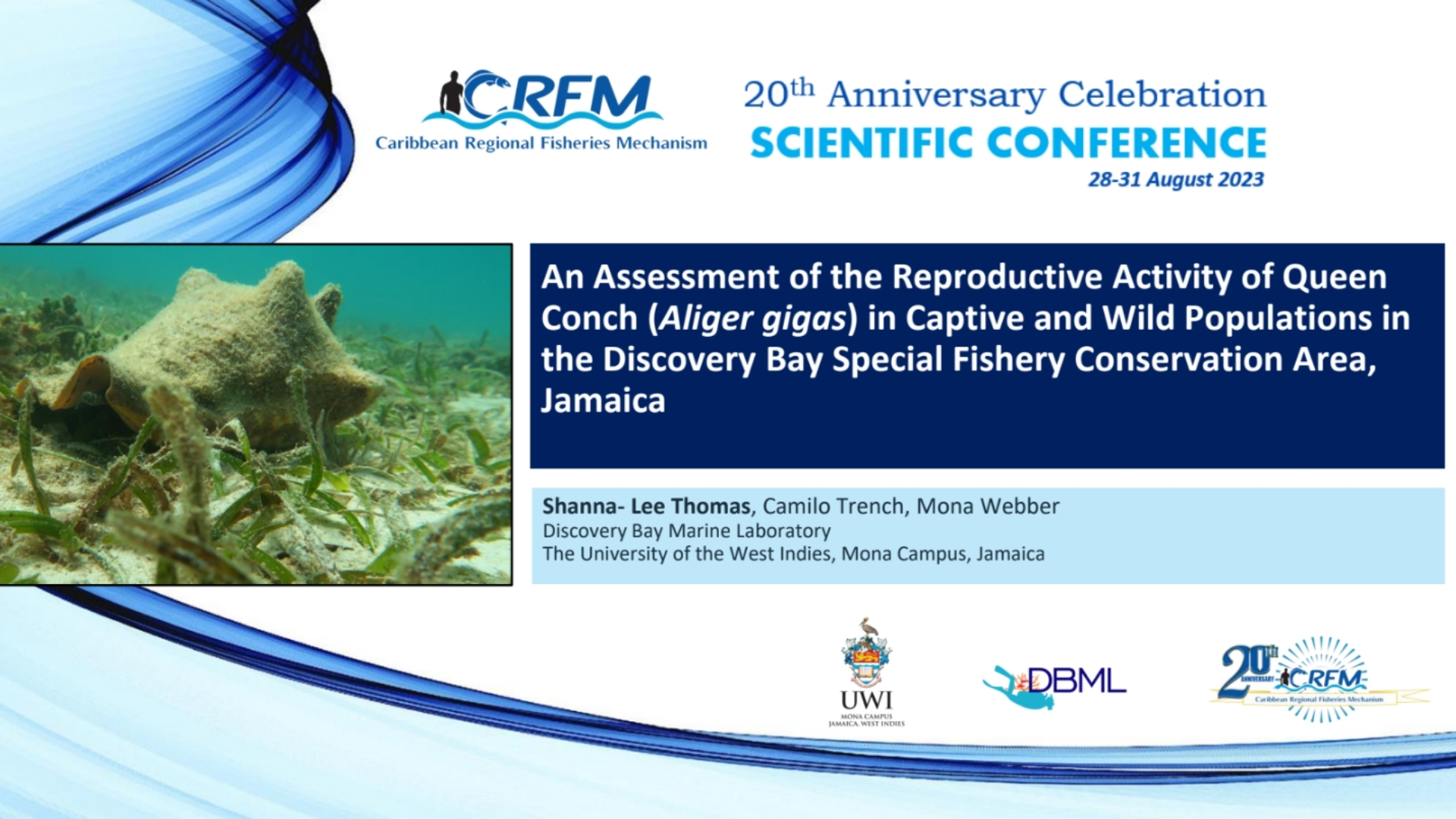
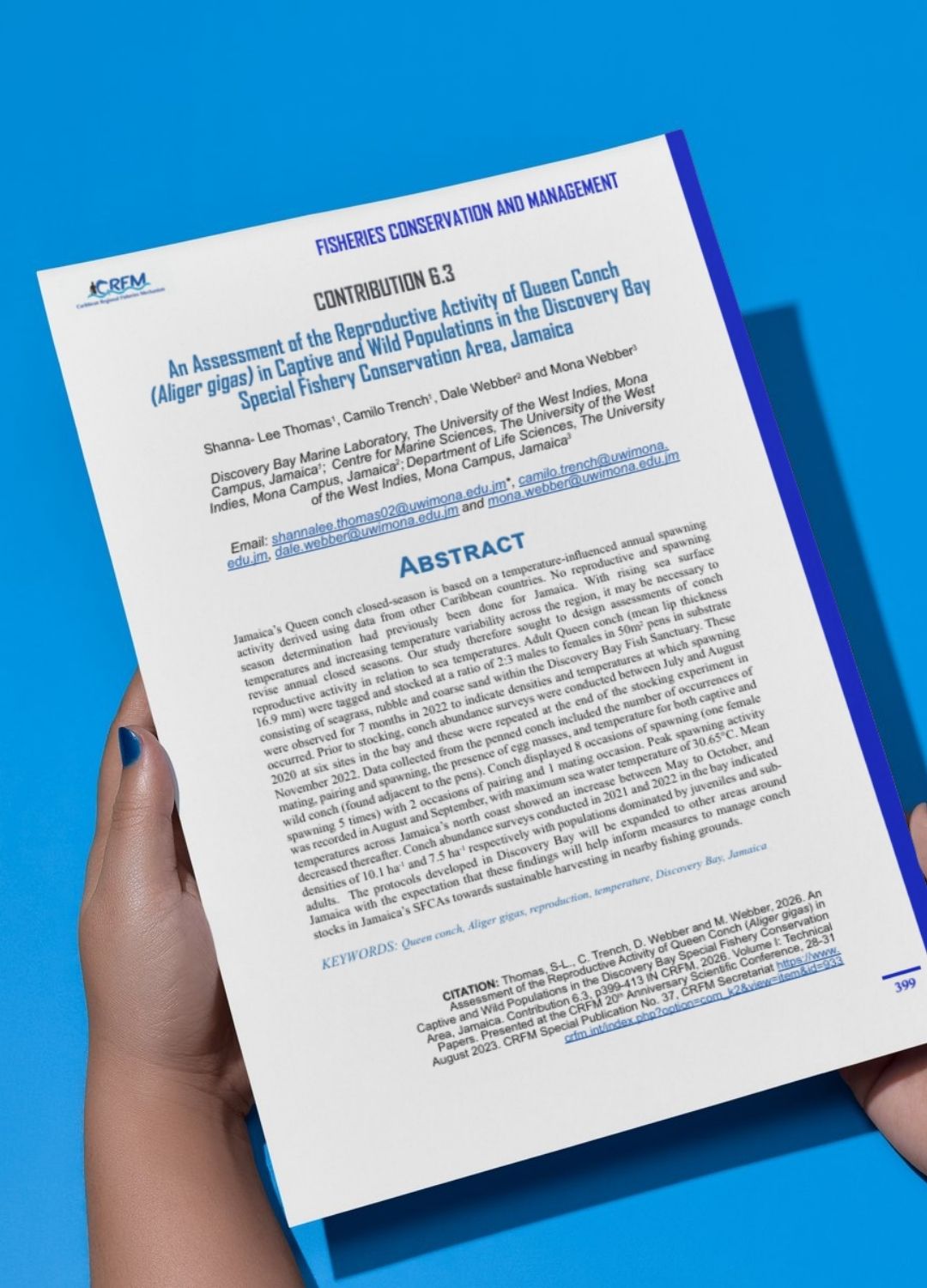 Jamaica’s Queen conch closed-season is based on a temperature-influenced annual spawning activity derived using data from other Caribbean countries. No reproductive and spawning season determination had previously been done for Jamaica. With rising sea surface temperatures and increasing temperature variability across the region, it may be necessary to revise annual closed seasons. Our study therefore sought to design assessments of conch reproductive activity in relation to sea temperatures. Adult Queen conch (mean lip thickness 16.9 mm) were tagged and stocked at a ratio of 2:3 males to females in 50m2 pens in substrate consisting of seagrass, rubble and coarse sand within the Discovery Bay Fish Sanctuary. These were observed for 7 months in 2022 to indicate densities and temperatures at which spawning occurred. Prior to stocking, conch abundance surveys were conducted between July and August 2020 at six sites in the bay and these were repeated at the end of the stocking experiment in November 2022. Data collected from the penned conch included the number of occurrences of mating, pairing and spawning, the presence of egg masses, and temperature for both captive and wild conch (found adjacent to the pens). Conch displayed 8 occasions of spawning (one female spawning 5 times) with 2 occasions of pairing and 1 mating occasion. Peak spawning activity was recorded in August and September, with maximum sea water temperature of 30.65°C. Mean temperatures across Jamaica’s north coast showed an increase between May to October, and decreased thereafter. Conch abundance surveys conducted in 2021 and 2022 in the bay indicated densities of 10.1 ha-1 and 7.5 ha-1 respectively with populations dominated by juveniles and sub-adults. The protocols developed in Discovery Bay will be expanded to other areas around Jamaica with the expectation that these findings will help inform measures to manage conch stocks in Jamaica’s SFCAs towards sustainable harvesting in nearby fishing grounds.

HOW TO CITE: Thomas, S-L., C. Trench, D. Webber and M. Webber, 2026. An Assessment of the Reproductive Activity of Queen Conch (Aliger gigas) in Captive and Wild Populations in the Discovery Bay Special Fishery Conservation Area, Jamaica. Contribution 6.3, p399-413 IN CRFM, 2026. Volume I: Technical Papers. Presented at the CRFM 20th Anniversary Scientific Conference, 28-31 August 2023. CRFM Special Publication No. 37, CRFM Secretariat https://www.crfm.int/index.php?option=com_k2&view=item&id=933
POWERPOINT
VIDEO PRESENTATION
FULL SCIENTIFIC PUBLICATION
Download CRFM Special Publication No. 37:
Proceedings of the CRFM 20th Anniversary Scientific Conference
KEY LINKS
Scientific Conference Home Page
Scientific Conference Proceedings Page
Explore all 20th Anniversary Scientific Papers
NOTE
If you have challenges accessing or downloading documents in this series, please email us at This email address is being protected from spambots. You need JavaScript enabled to view it. , copied to This email address is being protected from spambots. You need JavaScript enabled to view it. , or call us at +501-223-4443. Some browsers do not properly load Google Drive documents, so if you have challenges accessing the PowerPoint slides or the full special publication, try switching to another browser such as Google Chrome or Microsoft Edge.