 Anguilla
 Antigua and Barbuda
 Grenada
 Bahamas
 Barbados
 Belize
 Dominica
 Guyana
 Haiti
 Jamaica
 Montserrat
 St. Kitts and Nevis
 St. Lucia
 St. Vincent and the Grenadines
 Suriname
 Trinidad and Tobago
 Turks and Caicos

From Sea to Market: Eastern Caribbean Fishers Explore Belize’s Lobster Industry and Regional Trade Opportunities
By Dr. Marc Williams, CRFM Executive Director
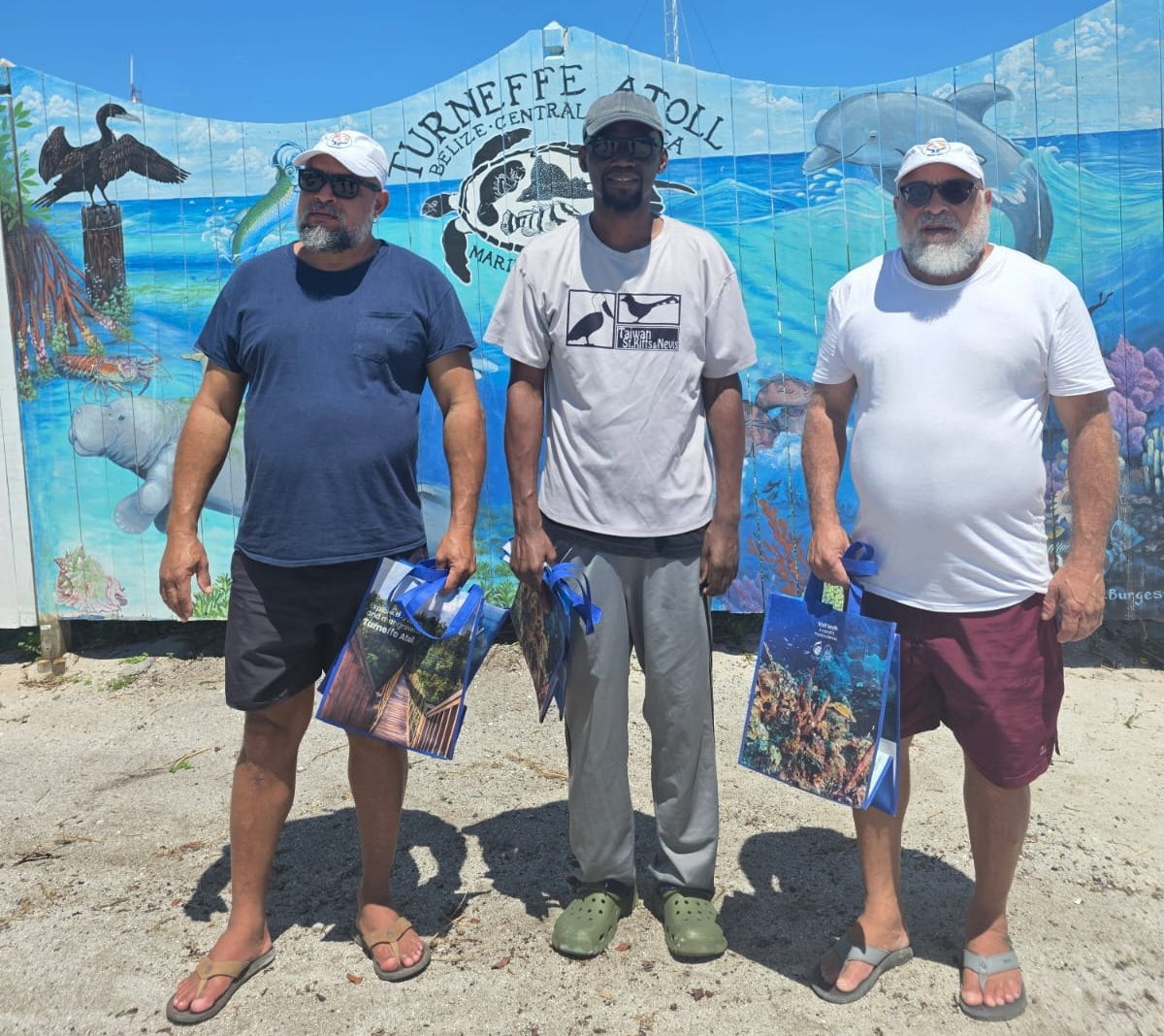
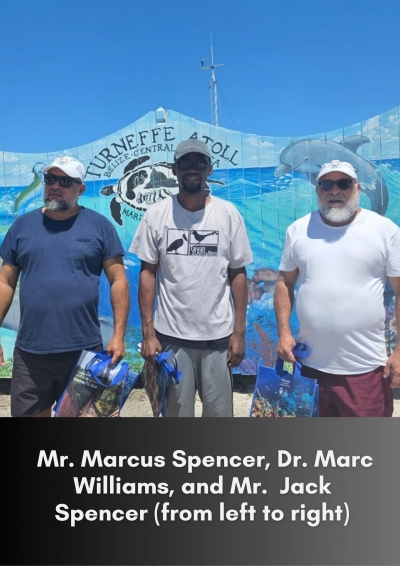
Mr. Marcus Spencer, Dr. Marc Williams, and Mr. Jack Spencer (from left to right)
A fisheries exchange in Belize has brought fishers and seafood businesspeople from the Eastern Caribbean face-to-face with Belizean fishers, cooperatives, fisheries managers, and conservation partners, sparking new conversations about how the Caribbean can strengthen trade in lobster and other seafood products while learning from successful fisheries management practices across the region.
From September 15–19, 2026, Mr. Jack Spencer and Mr. Marcus Spencer of St. Kitts and Nevis, along with Mr. Calvin Josiah of St. Martin, visited Belize to examine the country's lobster industry and explore opportunities to increase trade in fish and fish products between Belize and the Eastern Caribbean.
The Caribbean Regional Fisheries Mechanism (CRFM) and the Caribbean Network of Fisherfolk Organisations (CNFO) coordinated the week's program, with support from government agencies, fisher cooperatives, conservation partners, and local fishers in Belize.
The exchange took participants from cooperative processing facilities and government offices to fishing camps and co-management sites on Turneffe Atoll, offering a rare opportunity to follow Belize's lobster industry from sea to market.
Seeing the lobster value chain first-hand
The program began on September 15 with a meeting with the Belize Fishermen Cooperative Association (BFCA) Ltd., during which participants exchanged experiences and discussed the operations of Belize's fishing cooperative sector.
The delegation subsequently toured the facilities of the National Fishermen Producers Cooperative Society Ltd. (NFPCSL) and the Northern Fishermen Cooperative Society Ltd. (NFCSL).
The visits provided firsthand exposure to lobster receiving, handling, processing, and market preparation. Participants observed how value is added after lobster arrives at the cooperative and how the product moves through the supply chain to consumers.
The discussions also examined the role of cooperatives in organizing fishers, maintaining product quality, facilitating market access, and generating greater economic value from fisheries resources.
For the visiting fish businesspeople, the experience provided an opportunity to explore potential commercial relationships with Belizean suppliers and to understand better what would be required to increase the movement of lobster and other seafood products between Belize and Eastern Caribbean markets.
Understanding how Belize manages its fisheries
On September 16, the delegation met with representatives of Belize's Ministry of the Blue Economy. Participants received an overview of the history and development of the country's lobster fishery, its operations, and the legal and institutional mechanisms governing the industry.
Later that day, the group met with the CRFM for a broader regional discussion on lobster fisheries, seafood markets, and the opportunities and challenges of expanding intra-Caribbean trade in fish and fish products.
The program continued September 17 with detailed discussions hosted by the Belize Fisheries Department. Participants examined lobster and other fisheries operations, management arrangements, trade requirements, legislation, and compliance and enforcement.
These discussions underscored a central message of the exchange: building a profitable fisheries sector must go hand in hand with the responsible management of the resources that fishers, businesses and coastal communities depend on.
The Belize Fisheries Department, the Turneffe Atoll Sustainability Association (TASA), and CRFM also finalized arrangements for the delegation to observe fisheries management and lobster operations at Turneffe Atoll directly.
Taking the exchange to the fishing grounds
On September 19, the program moved from meeting rooms to the sea as TASA led the delegation on a field visit to Turneffe Atoll, supported by the Belize Fisheries Department, CRFM, and Belizean fisher Jason Young.
At Mr. Young's lobster fishing camp, participants saw how lobster traps are constructed and learned about the preparations Belizean fishers make for the lobster season. The encounter provided an opportunity for direct fisher-to-fisher exchange on fishing methods, practical experience, and the realities of operating a lobster fishing business.
The delegation then visited the Caye Bokel co-management site, which supports fisheries management in the southern portion of the Turneffe Atoll Marine Reserve, followed by Calabash Caye, a co-management site serving the reserve's middle portion.
The field experience underscored the importance of partnerships among fishers, government, and conservation organizations for sustainably managing valuable fisheries resources.
Participants see potential for wider Caribbean exchanges
The visiting delegation praised the hospitality and openness of the organizations and individuals who supported the program.
Jack Spencer expressed appreciation for the willingness of Belizean fisherfolk, the Government of Belize, TASA and CRFM to accommodate the delegation and openly share their experiences.
Marcus Spencer said he was impressed by the fisheries management practices he observed and would like other Caribbean fishers to benefit from similar opportunities.
“The fisheries in Belize are well managed, and I would love for other fishers in the Caribbean to have similar experiences,” Spencer said.
Calvin Josiah highlighted the potential for greater fisheries trade between Belize and the Eastern Caribbean, while noting that transportation and logistics will be critical to transforming commercial interest into sustainable trade.
The observation points to a wider challenge facing intra-regional seafood commerce: ensuring that transportation, cold-chain systems, distribution arrangements and other logistics can efficiently connect producers with Caribbean markets.
Connecting Caribbean fishers, businesses, and markets
The Belize exchange demonstrated the value of practical fisher-to-fisher, cooperative-to-cooperative, and business-to-business exchanges to strengthen Caribbean fisheries. Such initiatives can enable fishers to learn techniques directly from their counterparts, expose fisheries entrepreneurs to processing and value-addition opportunities, strengthen relationships among cooperatives, and connect seafood producers with prospective buyers.
The visiting fishers and businesspeople thanked the BFCA, NFPCSL, NFCSL, the Ministry of the Blue Economy, the Belize Fisheries Department, TASA, CNFO, and CRFM, as well as the local fishers and other partners who contributed to the program. The delegation expressed hope that the visit will mark the start of longer-term cooperation between Belize and fisheries stakeholders in St. Kitts and Nevis, St. Martin, and the wider Caribbean.
The opportunity extends beyond lobster. Stronger regional connections could support increased trade in Caribbean seafood, greater value addition, stronger fisheries enterprises, improved food and nutrition security, and more resilient livelihoods for fishing communities. For fishers and fisheries entrepreneurs elsewhere in the region, the Belize experience also invites them to imagine what similar exchanges could achieve.
The Caribbean Sea does not have to separate the region's fishing communities and markets. Through greater cooperation, knowledge exchange, and trade, it can increasingly become the link that connects them.
Caribbean Fisheries Ministers approve new protocols on marine spatial planning, IUU fishing, and seafood traceability
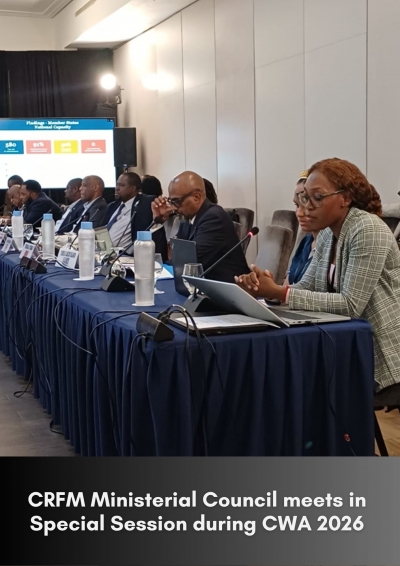
Trelawny, Jamaica, 29 September 2026 (CRFM)—The Ministerial Council of the Caribbean Regional Fisheries Mechanism (CRFM) convened its 17th Special Meeting at the Ocean Coral Spring Resort in Trelawny, Jamaica, on Monday, 28 September 2026, during the 20th Caribbean Week of Agriculture. Under the chairmanship of Antigua and Barbuda, the Ministers responsible for fisheries, aquaculture, and the blue economy approved twelve resolutions, solidifying their decisions regarding the future policy direction of the region’s fisheries and aquaculture sector with respect to data and information, marine spatial planning, traceability across seafood value chains, and illegal, unreported, and unregulated (IUU) fishing.
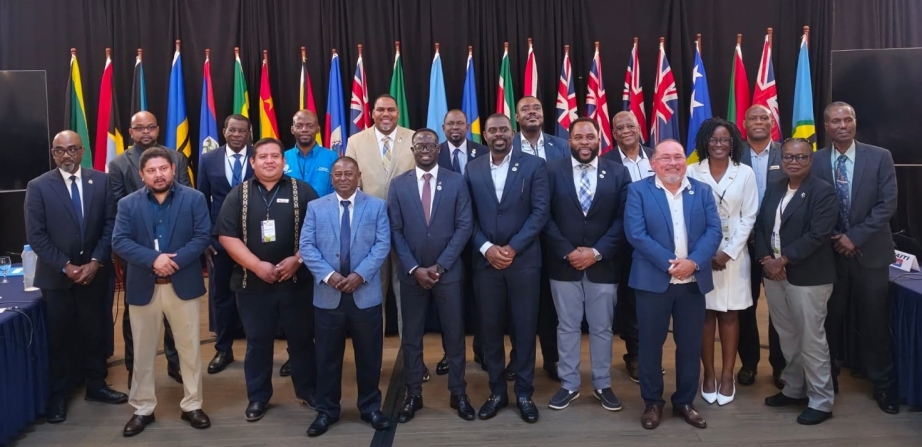
Delegation heads from CRFM Member States at the end of the 17th Special Meeting of the Ministerial Council in Jamaica (Photo – CRFM Secretariat)
In his opening remarks, the Chair of the CRFM Ministerial Council, Hon. Randy Baltimore, Minister of State in the Ministry of Agriculture, Lands, Fisheries and the Blue Economy, Antigua and Barbuda, said that this year’s theme for Caribbean Week of Agriculture, ‘The New F.A.C.E. of Caribbean Food Systems,’ focusing on Food Security, Agri-Business, Climate-Smart Technologies, and Export Expansion, speaks directly to the CRFM’s work.
“Fisheries and the blue economy must remain an integral part of each of these pillars,” Minister Baltimore said. “Our fisheries sector contributes not only to food and nutrition security, but also to livelihoods, trade and the economic resilience of our coastal communities. Yet we continue to face challenges from climate change; marine resource pressures; illegal, unreported and unregulated fishing; and changing market conditions.”
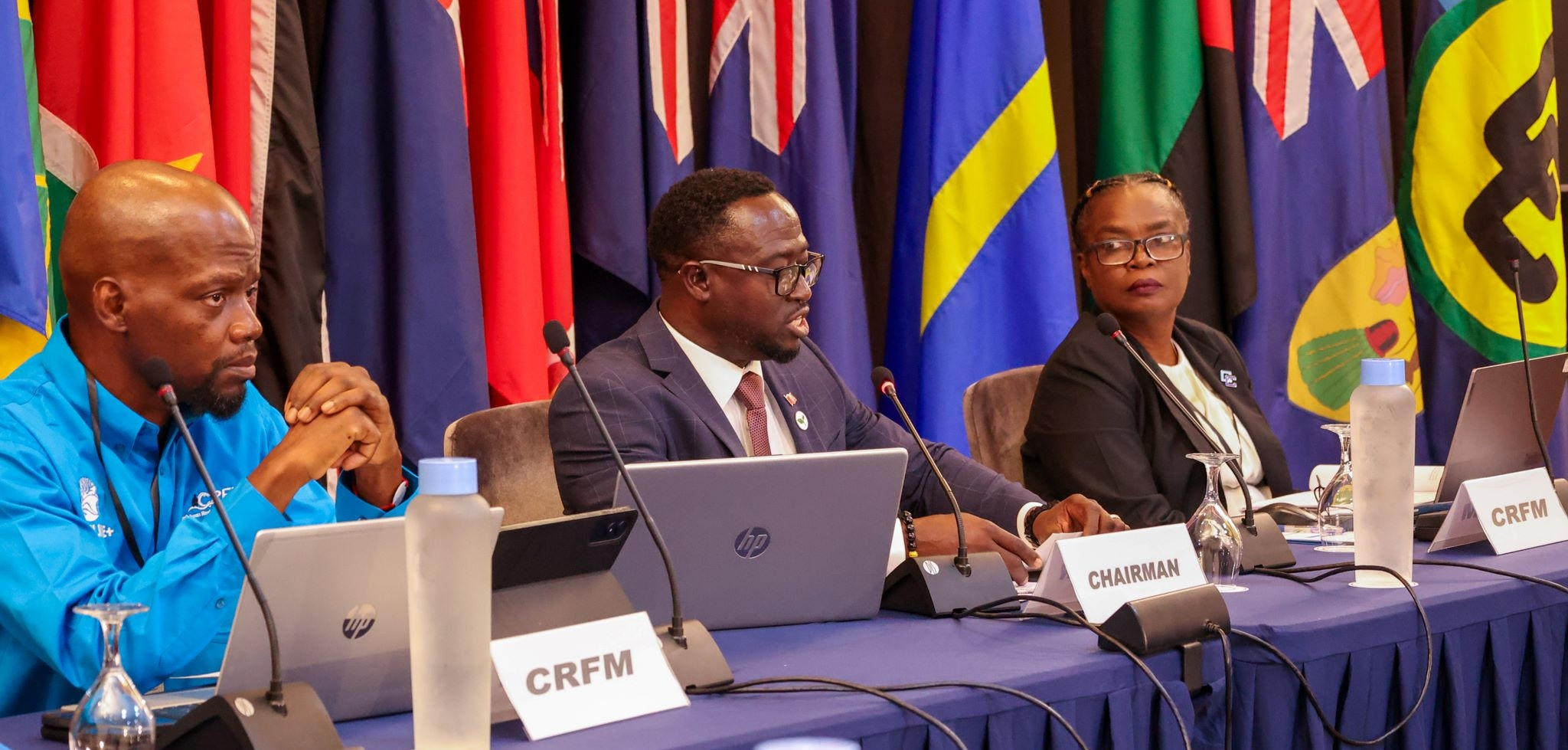
Minister Baltimore addressing the Council, flanked by CRFM Executive Director, Dr. Marc Williams (left), and Deputy Executive Director, Dr. Sandra Grant. (Photo – CARICOM Secretariat)
The CRFM Secretariat briefed the Ministers on status and trends in the sector. CRFM Statistics and Information Analyst, Mrs. June Masters, informed the Council that the most current regional data indicate that over half-a-million people are employed in the sector across the 17 CRFM Member States, including approximately 133,000 fishers and 5,000 aquaculture workers. She reported that over the five-year period spanning 2020 to 2025, each Member State reported steady growth in sector employment.
Meanwhile, the data indicate that the total ex-vessel value of fish produced by the region’s domestic fleet, representing the prices that fishers receive directly for their catch across over 30,000 vessels, almost doubled, presumably due to increased market prices. Mrs. Masters said that over the five-year period, this value increased from US$431 million to US$856 million, representing growth of 99%. At the same time, though, the total weight of the catch increased less dramatically, by 14%, from approximately 141,000 tons to approximately 160,000 tons.
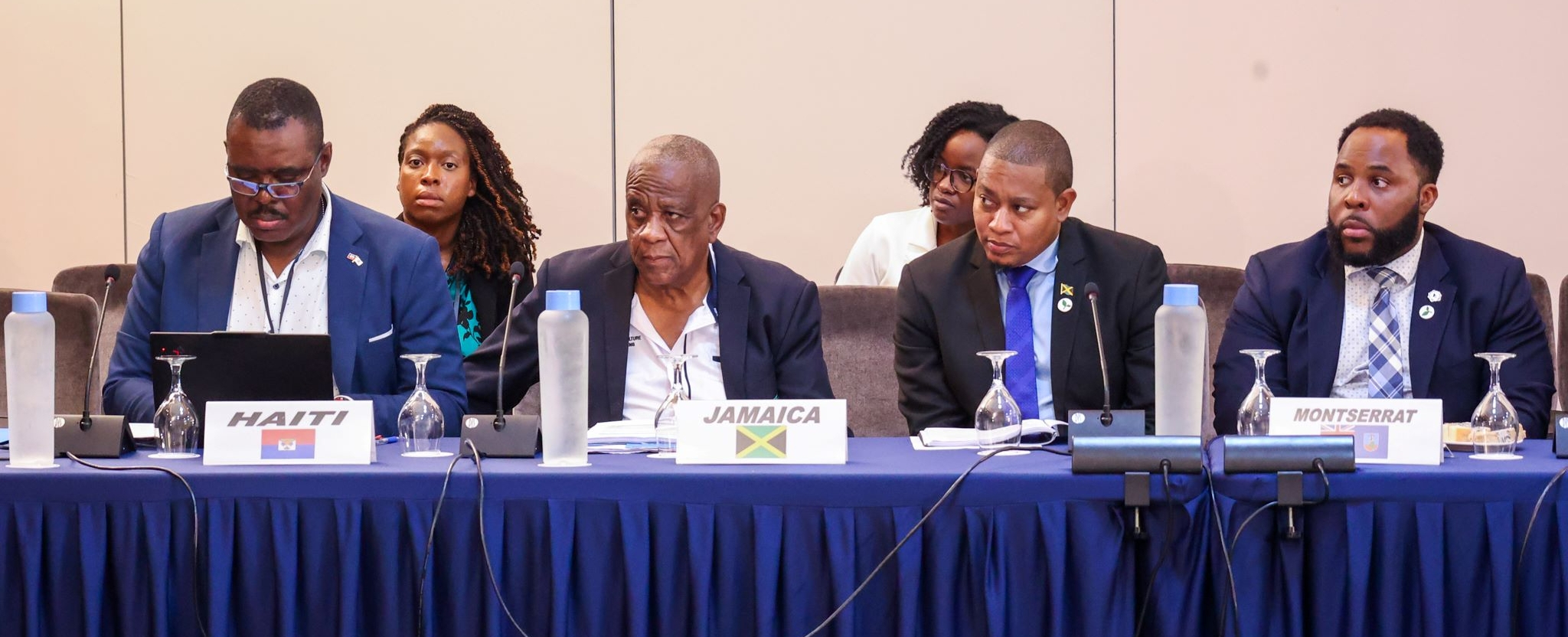
Representatives from Haiti, the host country – Jamaica, and Montserrat were among the policymakers who attended the Special Council meeting. (Photo – CARICOM Secretariat)
This is the backdrop against which the Ministerial Council discussed policies and the strategic direction of the sector, as well as the capacities of the CRFM Secretariat and its Member States to steer the sector’s sustainable growth and development. They deliberated on a recently concluded training and capacity needs assessment conducted by the CRFM in partnership with GRÓ Fisheries Training Programme under the auspices of UNESCO. The Council, which had commissioned the assessment, committed to taking prompt action to help bridge the capacity gaps.
Another important highlight of the Council meeting was the approval of three new protocols to the Caribbean Community Common Fisheries Policy (CCCFP). These are the Protocol on Marine Spatial Planning (MSP), the Protocol on Aquatic Foods Traceability, and the Protocol on Combating Illegal, Unreported and Unregulated (IUU) Fishing.
Reflecting on this milestone, CRFM Executive Director, Dr. Marc Williams, said: “Adopting these three new protocols marks a major step toward strengthening the governance, sustainability, and economic resilience of the Caribbean’s fisheries and marine resources. Together, the new CCCFP protocols on marine spatial planning, aquatic foods traceability, and combating illegal, unreported, and unregulated fishing give our Member States stronger regional frameworks to manage competing uses of our ocean space, build confidence and transparency in Caribbean seafood, and protect our fisheries from illegal activities.”
He added that these protocols also help safeguard the livelihoods of legitimate fishers, improve market access, strengthen food and nutrition security, and ensure that the benefits derived from our marine resources are shared sustainably.
“Importantly, these protocols demonstrate the Caribbean Community’s commitment to moving from policy to coordinated action and to building a modern, integrated, and resilient fisheries governance system. Our objective is clear: to protect the Caribbean’s fisheries and ocean resources while creating greater economic opportunities and securing their benefits for present and future generations,” Dr. Williams concluded.
In closing the Special Meeting of the Council, Minister Baltimore said: “Our countries face many shared challenges, but each also brings valuable experience and ideas to the table. I ask that we continue to learn from one another, share approaches that work, and follow through on the decisions made here. That is how we will build a stronger fisheries sector and a blue economy that creates lasting benefits for our fisherfolk and coastal communities.”
The CRFM Ministerial Council will also be represented at this Friday’s 127th Special Meeting of the Council for Trade and Economic Development (COTED) – Agriculture, which concludes the 20th Caribbean Week of Agriculture in Jamaica.
The Caribbean's Blue Economy Knowledge now has a new home

BE-CLME+ Knowledge Management Platform aims to connect policymakers, fisherfolk, private sector, and communities
Belize City, Belize (CRFM) – The Caribbean Regional Fisheries Mechanism (CRFM), in partnership with the Food and Agriculture Organization of the United Nations (FAO), and the Development Bank of Latin America and the Caribbean (CAF), have officially launched an open-access, Caribbean Blue Economy (BE) Knowledge Hub that brings together decades of the region’s expertise and insight on fisheries, aquaculture, and marine spatial planning.

The knowledge hub is a permanent, multilingual home for Blue Economy data, best practices, policy tools, and technical insight from across the participating countries–Barbados, Belize, Guyana, Jamaica, Panama, and Saint Lucia—built on CRFM’s expertise and the knowledge generated through the BE-CLME+ Project.
The digital platform is a crucial outcome of the Global Environment Facility (GEF)-funded, BE-CLME+: Promoting National Blue Economy Priorities Through Marine Spatial Planning in the Caribbean Large Marine Ecosystem Plus project.
Dr. Marc Williams, Executive Director, CRFM, stated, “The BE-CLME+ Knowledge Management Hub represents the continued drive of the CRFM to make knowledge products more accessible to all stakeholders; connecting policymakers, practitioners, researchers, and communities to the evidence they need to act, adapt, and lead.”
Dr. Williams further elaborated: “Small-scale fishers, women who process and trade the catch, youth deciding whether this industry has a future worth joining, and Indigenous communities whose stewardship of marine ecosystems spans generations — all will find, in this platform, a resource calibrated to their realities. That means accessible formats, multilingual content, and practical tools that translate regional expertise into actionable guidance for every practitioner in the value chain, including fisherfolk, academics, and policymakers alike.”
Powered by insights produced through the BE-CLME+ Project and CRFM, the Hub organises technical reports, policy briefs, fact sheets, and multimedia resources across seven thematic areas for easy discovery. Users can search, filter by theme, and access an AI-powered assistant — “Ask BE-CLME” — available in both English and Spanish to help navigate the platform's resources.
Across the six participating countries, governments now have a consolidated evidence base—which can be found at www.beknowledge.crfm.int—to drive marine spatial planning, sharpen national fisheries policy, and attract blue economy investment.

Dr. Renata Clarke, FAO Sub-Regional Coordinator for the Caribbean, said, “The importance of this platform cannot be overstated. It would help to unlock grey literature to better support decision-making by practitioners that is centered on benefits to communities. At present, piles of information and knowledge produced over decades sit unused, on desks and in drawers of national officers.”
With “over USD 200 million in annual Caribbean exports and more than half-a-million jobs” at stake across coastal communities from Belize to Barbados, according to the CRFM Statistics and Information Report – 2021/2022, the sustainable management of marine resources is an economic and food security imperative.
 Erick Castro, Principal Executive, CAF, said, “
Advancing a sustainable blue economy requires long-term investment in knowledge, governance, and human capital. Through BE-CLME+, we are helping to build the foundations that enable countries to make informed decisions, strengthen institutions, and unlock opportunities for inclusive and resilient growth. This platform is a tangible example of that commitment, transforming regional knowledge into a shared asset that will continue to generate blue value over time.
”
Sustainability Is Not a Cost — It Is the Business Case
The Caribbean sits at the centre of one of the most biodiverse marine regions on earth, yet a significant share of its seafood continues to be exported as raw, unprocessed product which leaves most of the value, and most of the jobs, somewhere else. Closing that gap is a trade strategy, not a conservation ambition.
The BE-CLME+ Knowledge Management Platform provides the market frameworks, training, and certification pathways for seafood standards, and value chain intelligence that make sustainable seafood profitable, scalable, and investable; while equipping businesses with the regional data they need to make decisions with confidence.
Since 2023, the BE-CLME+ project has aimed to maintain and preserve cultural heritage through sustainable fisheries management, improved livelihoods, and alternative livelihoods while strengthening the integration of fisheries and ecosystem management to restore, protect, and maintain marine biodiversity, productivity, and resilience of marine ecosystems.
###
Peter A. Murray is the new Regional Project Coordinator for the BE-CLME+ Project


The CRFM Secretariat is pleased to announce that Mr. Peter A. Murray is the new Regional Project Coordinator of the USD 48 million GEF/CAF/FAO/CRFM Project entitled, “Promoting National Blue Economy Priorities Through Marine Spatial Planning in the Caribbean Large Marine Ecosystem Plus Region" (BE-CLME + Project).
Mr. Murray formerly served as the CRFM's Advisor, Fisheries Management and Development, and he has played an active technical role for several decades on BE-related matters across the Caribbean, in addition to monitoring control and surveillance, illegal unreported and unregulated fishing and the broader spectrum of trans-national crime, gender, and fisheries nutrition, health and sanitary issues.
He comes highly qualified with 45 years of experience in fisheries as well as a Master of Philosophy degree in Biology and a Diploma in International Environmental Law. He has been senior-most Fisheries Biologist at Saint Lucia’s Department of Fisheries; senior Programme Officer at the OECS Secretariat, and Programme Manager at the Caribbean Regional Fisheries Mechanism Secretariat.
Mr. Murray, who succeeds Dr. Dayne Buddo, now has lead responsibility for overseeing BE-CLME+ project activities. As such, he will work towards ensuring alignment with strategic goals, timely delivery of planned activities and fostering collaboration among stakeholders and partners. His extensive experience and knowledge will be very helpful in advancing the objectives of the project, which is focused on marine spatial planning, marine managed areas, seafood value chain development, and ultimately the sustainable use and management of marine living resources, biodiversity conservation, stakeholder engagement and capacity-building throughout the region, and enhancing resilience to climate change and ocean acidification.
The CRFM welcomes Mr. Murray to his new role and wishes him all the best in this new chapter of his professional journey.
World Oceans Day Remarks from CRFM Executive Director, Dr. Marc Williams


Today, as we observe World Oceans Day, we are reminded that the Caribbean Sea and our surrounding oceans are not only a source of natural beauty but also the foundation of livelihoods, culture, food security, and economic opportunity for millions of people across our region. The theme of ocean stewardship has never been more important. For the Caribbean, the future of our oceans is inseparable from the future of our people. Healthy marine ecosystems support fisheries, tourism, transportation, coastal protection, and countless other services that sustain our economies and communities. As we celebrate this day, we must reaffirm our collective commitment to safeguarding our marine resources for present and future generations.
Small-scale fisheries remain the backbone of the fisheries sector in most Caribbean countries. Thousands of fishers, fish vendors, processors, and their families depend directly on the sea for their livelihoods and well-being. These fisheries contribute significantly to local food supplies, employment, poverty reduction, and cultural heritage. As global food systems face mounting pressures from climate change, economic uncertainty, and supply chain disruptions, investing in sustainable small-scale fisheries is essential to strengthening regional food and nutrition security. We must continue to empower fishing communities through improved management, access to finance, modern technology, capacity building, and policies that recognize their invaluable contributions to national and regional development.
At the same time, the Caribbean has tremendous opportunities to expand sustainable mariculture and aquaculture as part of a diversified Blue Economy. Responsible mariculture can increase domestic seafood production, reduce reliance on imports, create jobs, attract investment, and build resilience to climate-related shocks. Through innovation, science-based planning, and effective marine spatial management, we can unlock new opportunities in marine fish farming, seaweed cultivation, shellfish production, and other ocean-based industries while safeguarding marine biodiversity. The CRFM remains committed to supporting Member States in advancing sustainable Blue Economy initiatives that balance economic growth, environmental stewardship, and social inclusion.
However, the promise of our oceans cannot be realized if marine pollution continues to endanger our ecosystems. Plastic waste, abandoned fishing gear, land-based runoff, wastewater discharge, and other pollutants are degrading coastal habitats, damaging coral reefs, threatening marine life, and undermining fisheries productivity. Addressing marine pollution requires action by governments, businesses, communities, and individuals alike. On this World Ocean Day 2026, let us renew our commitment to reducing pollution at its source, strengthening waste management systems, promoting sustainable consumption, and protecting the marine environment on which our prosperity depends. Together, we can build a cleaner, healthier, and more resilient Caribbean Sea that continues to nourish our people, support our economies, and inspire future generations.
STAR-Fish


|
WHAT IS STAR-FISH AND WHY IT MATTERS |
||
| Fisheries across the Caribbean are highly dependent on fossil fuels, making them vulnerable to rising energy costs and climate risks. STAR-Fish seeks to demonstrate that: | ||
 Renewable energy reduces operational costsEnergy-efficient technologies improve productivityInclusive approaches strengthen long-term resilience |

|
PROJECT FOCUS AREAS |


|
PROJECT PROFILE |
||
|
Sustainable Technologies for Adaptation and Resilience in Fisheries - STAR-Fish Donor-funded by Global Affairs Canada |
||
|
The STAR-Fish Project seeks to demonstrate that energy costs can be substantially reduced by transitioning to renewable energy technologies. The project intends to ultimately increase clean energy transition in Caribbean fisheries and aquaculture by applying a gender-responsive approach to its interventions, as it supports the certification of low carbon or carbon neutral fisheries in the region and facilitates technical collaboration and knowledge exchange. The STAR-Fish Project is pivotal for the advancement of the CRFM’s 2022-2030 Strategic Plan. It particularly supports the attainment of Strategic Goal 4 (Section 4.1c), which envisions “Increased use of renewable energy and energy efficient harvesting, processing, and cold storage systems, and reduction of the region’s reliance on fossil fuels in fisheries and aquaculture.” The overall objective of STAR-fish is to enhance sustainable economic growth through building (or improving) resiliency of the Caribbean fisheries sector |


|
PROJECT COUNTRIES |
|
OUR TEAM |

CONTENT AND RESOURCES

CRFM Ministerial Council addresses fisheries, aquaculture, and blue economy priorities at 20th Regular Meeting

Belize City, Belize, 3 June 2026 (CRFM)—The Ministerial Council of the Caribbean Regional Fisheries Mechanism (CRFM), a regional inter-governmental body of the Caribbean Community (CARICOM), convened its Twentieth (20th) Regular Meeting today. The Council, comprised of Fisheries, Aquaculture, and Blue Economy Ministers from the Caribbean, deliberated via teleconference on key issues confronting the sector. These include bolstering aquaculture development, improving food security, strengthening resilience to climate and disaster risks through insurance, and notable gains in addressing illegal, unreported, and unregulated (IUU) fishing.
Before delving into these pressing matters, the Council elected Hon. Randy Baltimore, Minister of State in the Ministry of Agriculture, Lands, Fisheries and the Blue Economy, Antigua and Barbuda, as Chair. Minister Baltimore succeeds Hon. Kyle Hodge, Minister of Economic Development, Industry, Commerce, Lands, Planning, Water, and Natural Resources, Anguilla, who rendered stellar service as Chair of the CRFM Ministerial Council during the previous year.
In accepting the Chairmanship, Antigua and Barbuda reaffirmed its commitment to strengthening regional cooperation, promoting sustainable use of marine resources, supporting fisherfolk livelihoods, and advancing innovative solutions to challenges facing the fisheries sector, including climate change, illegal fishing, and marine resource management.
Minister Baltimore said: “The Government of Antigua and Barbuda looks forward to working closely with CRFM Member States and regional partners to further the sustainable development of the Caribbean’s fisheries and blue economy sectors during its tenure as Chair.”
He noted that he had recently been assigned to the portfolio following national elections in the Member State. Supported by the Chair of the Caribbean Fisheries Forum, Mr. Ian Horsford, Chief Fisheries Officer, Antigua and Barbuda, the Ministers effectively addressed a range of topics, resulting in the passage of 19 resolutions critical to the advancement of the fisheries and aquaculture sector.

Minister Baltimore chairing the Council meeting from Antigua and Barbuda (Photo: Government of Antigua and Barbuda)
In addressing the Council at the conclusion of the meeting, CRFM Executive Director, Dr. Marc Williams said: “The Caribbean stands at a pivotal moment when sustainable fisheries, aquaculture, the Blue Economy, climate resilience, and ocean governance must be integrated to secure prosperity for present and future generations. I encourage all Member States to maintain their strong engagement in implementing today's resolutions and to continue supporting the CRFM as a premier regional institution for fisheries and ocean governance.”
The Ministers approved a new 5-year aquaculture action plan, as well as a new biennial work plan and budget for the CRFM, spanning 2026-2027. They also received updates on three regional initiatives through which critical work is being undertaken by the CRFM, in collaboration with its Member States and institutional partners, to strengthen the sector. These are the Canadian-funded Sustainable Technologies for Adaptation and Resilience in Fisheries (STAR-fish) Project, the IICA/EDF-EU Food Security Project, as well as the GEF/FAO/CAF/CRFM BE-CLME+ Project: Promoting National Blue Economy Priorities Through Marine Spatial Planning in the Caribbean Large Marine Ecosystem Plus.
“The Council’s decisions on the CRFM work plan and budget, financial management, staffing, and strategic priorities provide a strong foundation for advancing the CRFM’s goals and delivering tangible benefits to the people who depend on our marine resources,” Dr. Williams said.
The Council is scheduled to meet again later this year, during the 20th Caribbean Week of Agriculture in Jamaica.
###
Caribbean Fisheries Forum hosts its 24th Regular Session ahead of Ministerial Meeting

Belize City, Belize, 24 April 2026 (CRFM)—The Caribbean Fisheries Forum, comprised of 17 heads of fisheries authorities across the Caribbean Community (CARICOM), is convening its 24th Regular Meeting this week. The Forum, which provides technical guidance to the Caribbean Regional Fisheries Mechanism (CRFM), began its meeting on Thursday, 23 April 2026, with deliberations on the CRFM’s Seventh Biennial Work Plan (2026-2027), which sets the framework for the regional fisheries body to advance the development of fisheries and aquaculture across the region. Today’s agenda is focused on pressing regional and international developments, as well as the status and trends of the sector.

Across the Caribbean Community, approximately half-a-million people are employed in the fisheries and aquaculture sector, including 122,198 fishers, 4,926 aquaculture farmers, and 412,078 others who hold fisheries-dependent jobs across the value chain.
Dr. Marc Williams, Executive Director of the CRFM, said: “The Caribbean Fisheries Forum provides the CRFM with a platform to discuss fish stocks, the blue economy, marine ecosystems, and fishing activities. Given the proximity of the Member States in the Caribbean and the transboundary nature of the fish stocks, cooperation is essential for the sustainable management of these stocks.”
He added that, “The Forum meeting provides a platform for the Member States to share data, examine common challenges such as illegal, unreported, and unregulated (IUU) fishing, climate change, habitat degradation, and overfishing, and coordinate policies that protect resources while supporting livelihoods. Additionally, it reinforces partnerships among governments, fisherfolk organizations, researchers, and other nongovernmental organizations to foster trust, harmonize plans, improve enforcement, and attract funding for joint projects that benefit the CRFM Member States.”
On Thursday, 24 April 2026, the Forum also held elections for a new Chair and Vice Chair, as well as members of the Executive Committee of the Forum and the Resource Mobilization Sub-committee. After the elections, Mr. Ian Horsford, Chief Fisheries Officer, Antigua and Barbuda, assumed the Chair, succeeding Mr. Remone Johnson of the Turks and Caicos Islands for the next year.
"In these times of geopolitical uncertainty, CRFM—through its various organs such as the Forum—remains a shining example of what can be achieved through multilateralism as we chart the way forward for the sustainable development of Caribbean fisheries and blue economy," Mr. Horsford said.
The two-day meeting, which concludes today, Friday, 24 April, addresses the sustainable management of fisheries and aquaculture, as well as cross-cutting dimensions related to climate change, adaptation, and innovation, including the strategic adoption of renewable energy options within seafood value chains. The Forum’s deliberations also encompass initiatives to combat IUU fishing and fisheries crime, as well as gender mainstreaming in fisheries.
Furthermore, the Forum is providing technical guidance on two new protocols under the Caribbean Community Common Fisheries Policy (CCCFP): a protocol on marine spatial planning and the other on aquatic foods traceability, which involves tracking seafood across the value chain. Deliberations extend to the World Trade Organization (WTO) Fisheries Subsidies Agreement, the Agreement under the United Nations Convention on the Law of the Sea on the Conservation and Sustainable Use of Marine Biological Diversity of Areas beyond National Jurisdiction (the BBNJ Agreement), as well as the International Legally Binding Instrument on Plastic Pollution—all important legal instruments for the sector.
This week’s Forum meeting precedes the upcoming 20th Regular Meeting of the CRFM Ministerial Council, comprised of Ministers from the CRFM’s Member States.
CRFM and GRÓ FTP engage in Iceland on strategies to strengthen Caribbean fisheries

Belize City, Belize, 3 March 2026 (CRFM)—Representatives of the Caribbean Regional Fisheries Mechanism (CRFM), headquartered in Belize, and the GRÓ Fisheries Training Programme (FTP), met last week to explore ways to strengthen cooperation with CRFM Member States and to further enhance the region's capacity in fisheries management and development. The discussion took place on Friday, February 27, 2026, at GRÓ FTP in Reykjavik, Iceland. Dr. Marc Williams, CRFM Executive Director, met with Mr. Thor Ásgeirsson, GRÓ FTP Director, and Stefán Úlfarsson, Specialist, to chart the way forward.

From left to right: Dr. Marc Williams, CRFM Executive Director; GRÓ FTP 2025-2026 fellow - Ms. Deandra Roberts of Jamaica; Mr. Thor Ásgeirsson, GRÓ FTP Director; and GRÓ FTP 2025-2026 fellow - Ms. Annakay Crawford of Jamaica
This engagement builds upon 18 years of collaboration between the parties. The CRFM and GRÓ FTP, formerly the United Nations University Fisheries Training Program (UNU FTP), entered into a memorandum of understanding in 2008 to enhance institutional capacity. Under this arrangement, Caribbean fisheries practitioners continue to benefit from GRÓ FTP training, including short courses, six-month training programs, as well as master’s and doctoral degrees.


Currently, the CRFM and GRÓ FTP are conducting a capacity needs assessment of the CRFM fisheries administrations and the CRFM Secretariat. Two GRÓ FTP fellows from Jamaica, Ms. Annakay Crawford and Ms. Deandra Roberts, are gathering and analyzing data for the assessment, which will provide the evidence that the Member States and the CRFM Secretariat need to chart the future direction of their respective organizations.
On Wednesday, February 25, 2026, at the FAO’s 2nd Committee on Fisheries (COFI) Subcommittee Meeting on Fisheries Management in Iceland, Ms. Crawford and Ms. Roberts briefed the Saint Vincent and the Grenadines delegation—Honorable Conroy Huggins, Minister of Fisheries, Marine and Land Conservation, and Climate Resilience, and Mr. Kris Isaacs, Senior Fisheries Officer—on their progress. The delegation reaffirmed its commitment to support the successful completion of the assessment reports.
Last September, the CRFM Ministerial Council—comprised of ministers responsible for fisheries, aquaculture and the blue economy from across the Caribbean Community (CARICOM)—issued a resolution approving the CRFM Capacity Needs Assessment Roadmap 2025. The Council said it looks forward to the successful completion of the regional and national capacity assessment summaries that would support a more holistic response in addressing the gaps at both the regional and national levels.
Dr. Williams said: “The CRFM Secretariat acknowledges and thanks all Member States that have been contributing to the Capacity Needs Assessment. These inputs have been essential in enabling a comprehensive regional analysis of our institutional and human capacities, in accordance with the directives of the CRFM Ministerial Council. Continued collaboration is critical as the process advances toward validation and subsequent presentation to the Council.”
Since 2008, sixty-five (65) Caribbean fisheries professionals have benefited from training through GRÓ FTP. Several of the program's alumni have moved on to leadership roles within fisheries administrations, the CRFM Secretariat, and the CRFM Ministerial Council. Notably, Ministerial Council member, the Honorable Jullan Defoe, Minister of State in the Ministry of Agriculture, Fisheries, Blue and Green Economy in Dominica, and the CRFM Secretariat’s Executive Director, Dr. Williams, both received fisheries training from GRÓ FTP.
GRÓ FTP, which promotes sustainable use and management of living aquatic resources, has reaffirmed its desire to continue supporting the development of fisheries management capacity and the training of future Caribbean leaders.
CRFM 20th Anniversary Technical Papers and National Reports now online!

The Caribbean Regional Fisheries Mechanism (CRFM) is pleased to announce that the full proceedings of the Twentieth Anniversary Scientific Conference is now available online. The publication is listed on our official publications page, and individual papers can be accessed below. The publication is available in two volumes: Volume I: Technical Papers and Volume II: National Reports.
The CRFM expresses its sincerest gratitude and appreciation to all who contributed in any way to this monumental undertaking, especially the 130 authors who contributed their invaluable expertise. Together, the publications total almost 900 pages, comprised of 77 papers, including 17 reports on the status of fisheries and aquaculture across the CRFM Member States. Below are the 10 thematic areas captured in the publication:

FULL SCIENTIFIC PUBLICATION
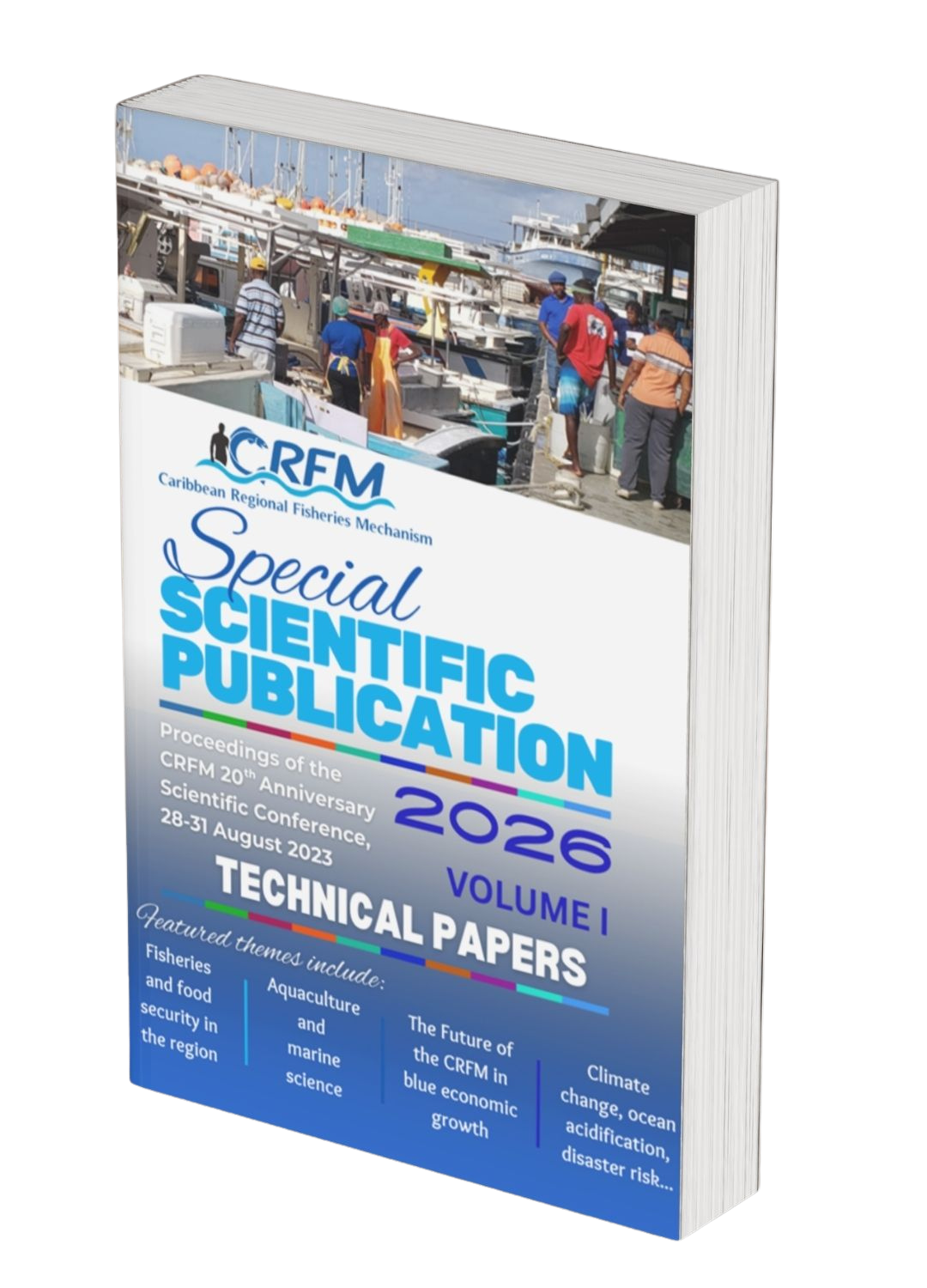
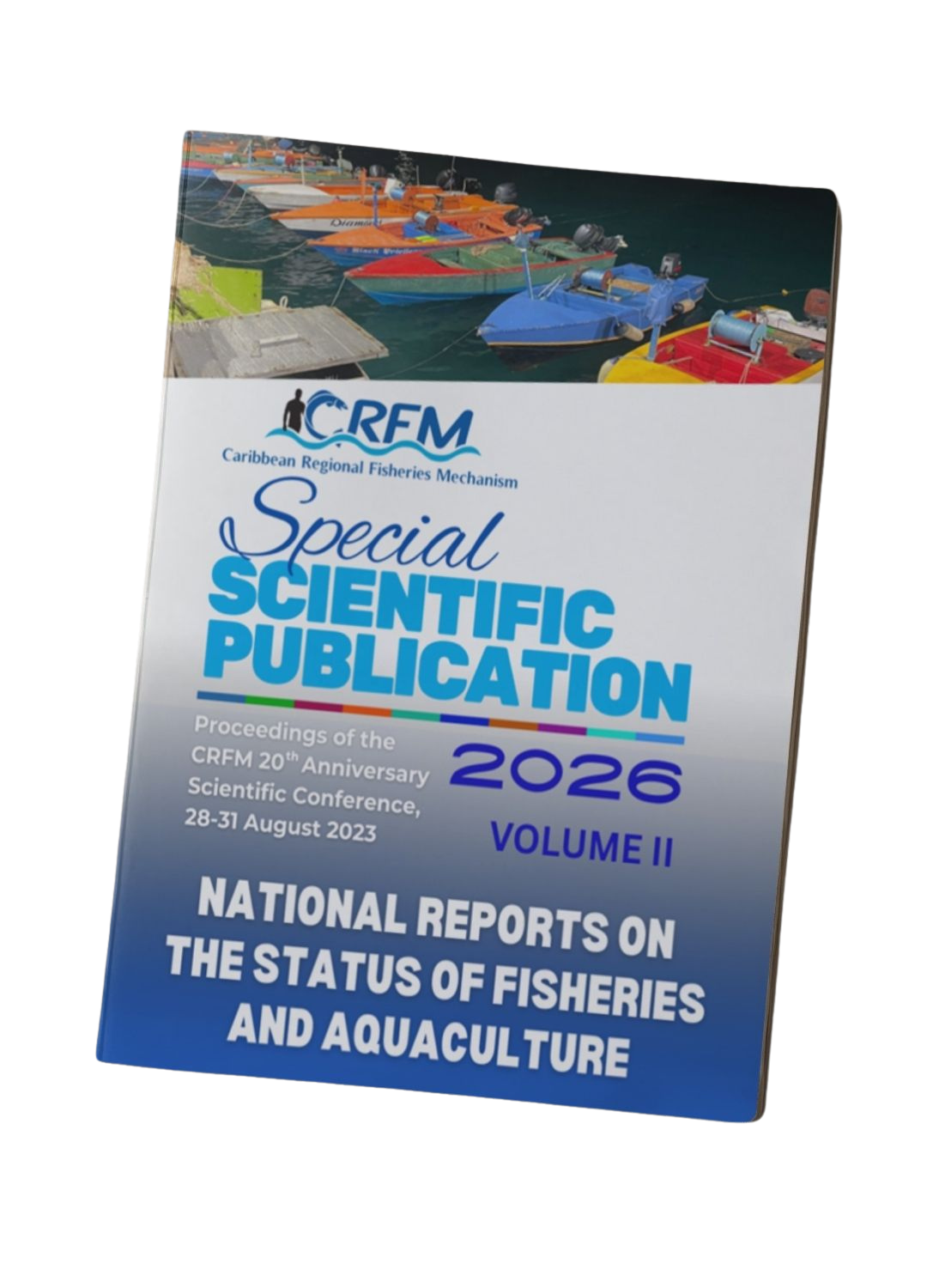
Download CRFM Special Publication No. 37:
Proceedings of the CRFM 20th Anniversary Scientific Conference
LIST OF PUBLISHED PAPERS AND REPORTS
Session I: Fisheries and Food Security in the Region
1.1 | Driving Circular Economy By Transforming Fish Parts From Processing (“Fish Waste”): a Barbadian Case Study for Resource Optimization in the Caribbean Countries
Authors: Yvette Diei Ouadi et al

1.2 | Food for Thought: Fisheries and Aquaculture Contributions to Food Security in the Caribbean
Authors: Maria Delesalle et al
1.3 | Strengthening Sanitary and Phytosanitary Capacity of the Fisheries Sectors within CARIFORUM Countries for Improved Market Access Under the Economic Partnership Agreement
Authors: Janet L. Lawrence and Peter A. Murray
1.4 | Inventory of Marine Fish and Aquaculture Factory Processing Establishments in CRFM Member States
Authors: S. C. Grant et al
Session II: Legal, Policy and Institutional Frameworks for Fisheries
2.1 | The Regional Aspect of Fisheries Governance in the Wider Caribbean
Authors: Robin Mahon and Lucia M. Fanning
2.2 | Review of the Legal and Policy Framework for Sustainable Use of the Living Marine Resources of the CRFM Member States
Author: Milton O. Haughton
2.3 | Sustainable Fisheries Management and Development Suite of Laws for the Barbados Fisheries Sector
Authors: Shelly-Ann Cox et al
2.4 | A Review of National Intersectoral Committee (NIC) Governance Arrangements for Shrimp and Groundfish in the Northern Brazil Shelf Large Marine Ecosystem (NBSLME)
Author: Sanya S. Compton
2.5 | Developing a Policy Framework for Gender Mainstreaming in the Fisheries Sector
Author: Peter A. Murray
2.6 | The WTO Agreement on Fisheries Subsidies: CARICOM’s Interests, Participation and Outcome
Author: Nigel Durrant
2.7 | The Need for Rigor in the Fisheries Space - Why the Term “IUU Fishing” is a Hindrance
Author: Ian Ralby
Session III: Data and Science for Sustainable Fisheries Development & Management
3.1 | Implementing a Monitoring and Evaluation Plan to Inform Fisheries Governance in the Wider Caribbean
Authors: Lucia M. Fanning and Robin Mahon
3.2 | Analysis of Trends in Production, Fleet, Trade and Economic Contribution of the Fisheries and Aquaculture in CRFM Member States
Authors: Pranaya Parida et al
3.3 | Data Management for Fisheries Management: Addressing Challenges and Unleashing Revolutionary Innovations
Author: Vilhjálmur Hallgrímsson
3.4 | Leveraging Lessons From the Caribbean to Enhance the Value-Chain Approach in Developing Sustainable Small-Scale Capture Fisheries
Authors: Alexander S.T. Girvan et al
3.5 | Commercial Sea Cucumber Stock Assessment to Determine Sustainable Quotas in Belize
Authors: Kenneth Esquivel et al
3.6 | DIGIFISH: Data Driven Solutions to Inform Decision Making
Authors: Shelly-Ann Cox et al
3.7 | Video methodologies for deep water surveying of queen conch (Strombus gigas): a comparison study in Turks & Caicos Islands
Authors: J Van Rijn et al
3.8 | Modern Tools for Fisheries Data Collection and Data Management: Experiences From Suriname
Authors: Tomas Willems et al
3.9 | Assessing the Spatio-Temporal Dynamics and Overfishing Implications for Guyana’s Seabob Shrimp Industry
Authors: Ray Netwon and Mikhail Amsterdam
3.10 | Digitizing the Vessel Inspection Process in Barbados
Authors: Adriel Jackman et al
3.11 | Comparative Analysis of Shark Capture Data: Species Composition, Diversity, and Abundance Along the Northeast Coast of Trinidad
Authors: Imran Khan et al
3.12 | Socio-Economic Features of Antigua’s Small-Scale Fisheries Sector – Implications for Economic Security and Sustainable Development
Author: Ian Horsford
3.13 | The Evolution of Data Collection, Analysis and Reporting of Fisheries Data for the Commonwealth of Dominica
Authors: Derrick Theophile and Kurt Hilton
3.14 | Improving Social and Economic Resilience Through Enhanced Regional Trade in Fish and Seafood
Authors: Milton O. Haughton and Adele O. Ramos
3.15 | Biology and Diseases of Panulirus argus on Saint Kitts and Nevis
Authors: Nicole A. M. Atherley Herbert et al
Session IV: Capacity Building in Fisheries
4.1 | CRFM’s Training and Capacity Building Activities: 2003-2023
Authors: Pamela Gibson et al
4.2 | Investigating the Economic Implications of Weather-Related Damages and Theft on Fishing Vessels: a Survey-Based Analysis in the Coastal Communities of Trinidad
Authors: Vivan Alexander et al
4.3 | Women Empowerment in the Belize Fishing Industry
Authors: Sandra C. Grant et al
4.4 | Reflections on a Collaborative Program to Build Capacity in the Caribbean Fisheries Resource Management Sector
Authors: Nancy Montes and Charles Sidman
Session V: Aquaculture and Marine Science
5.1 | A Bioeconomic Approach for Sea Cucumber Mariculture in the Caribbean
Authors: Ricardo Anthony Morris (rescheduled to Thursday)
5.2 | Looking Back Before Moving Forward: Learning From History to Develop Aquaculture and Mariculture in Barbados
Authors: Christopher Parker and Colvin Taylor
5.3 | Restorative Aquaculture: How Commercially Important Sea Urchins Can Aid in Coral Reef Recovery
Author: Stacey M. Williams
5.4 | Investigating the Effectiveness of Three Different Growing Methods for Seamoss Farming in Saint Lucia
Author: Makeba B. Felix
5.5 | Evaluating the outcomes of selective breeding in optimizing the growth performance of tilapia (Oreochromis spp.) for commercial production in the Bahamas
Authors: Mia Avril and John Reid
5.6 | Outlook and Key Considerations for Sustainable Commercial Aquaculture Development in CARICOM
Authors: Samia Sarkis et al
Session VI: Fisheries Conservation and Management
6.1 | Historical Local and Traditional Knowledge and Key Messages for Present-Day Holistic Fisheries Management – An Example from Haiti
Authors: Susan Singh-Renton et al
6.2 | Sustainable Harvesting of Commercial Species in the Belize Exclusive Economic Zone
Authors: Silvana N. R. Birchenough et al
6.3 | An Assessment of the Reproductive Activity of Queen Conch (Aliger gigas) in Captive and Wild Populations in the Discovery Bay Special Fishery Conservation Area, Jamaica
Authors: Shanna-Lee Thomas et al
6.4 | Use of a Maritime Domain Awareness Tool for Detecting Fishing Activity in the Waters of Caribbean States
Authors: Peter A. Murray et al
6.5 | Update on the Status and Management of the Caribbean Spiny Lobster Fisheries in the CARICOM Region
Authors: Maren Headley et al
6.6 | What is the Right Balance Between International Management and the Involvement of Fishing Communities in the Management of Caribbean Spiny Lobster Fisheries?
Author: Lester Gittens
6.7 | The Fish Sanctuaries Network: Jamaica’s Quiet Fisheries Success Story
Authors: Karl A. Aiken et al
6.8 | Ten Years of Caribbean Spiny Lobster (Panulirus argus) Closed Season: Evidence From Antigua and Barbuda’s Small-Scale Fishery
Authors: Ian Horsford and Hilroy Simon
6.9 | Utilization of Artificial Reefs for Enhancement of Spiny Lobster Resource
Authors: Hiroaki Terashima et al
6.10 | Uncovering Stakeholder Perspectives on Belize's Managed Access Program: Implications for Sustainable Fisheries Management
Author: Eric Wade
6.11 | Recommended Strategies to Protect Parrotfish Populations in Barbados
Authors: Christopher Parker and Shelly-Ann Cox
Session VII: Climate Change, Ocean Acidification, Disaster Risk Management and Recovery
7.1 | The Role of Climate Risk Insurance in Building Resilience of the Fisheries Sector– the Coast (Caribbean Oceans and Aquaculture Sustainability Facility) Example and Application
Authors: Isaac Anthony et al
7.2 | Gender Perspectives in Social, Blue and Climate Justice
Authors: Maria Pena and Patrick Mcconney
7.3 | Sargassum in the Caribbean: Challenges and Opportunity for Blue Growth Based on the Circular Economy Approach
Authors: Mario Ayalon et al
Session VIII: International & Regional Cooperation and Partnerships
8.1 | Fisherfolk Organisations in Fisheries Governance and Policy
Authors: Patrick Mcconney and Maria Pena
8.2 | Regional Cooperation Among CRFM, OSPESCA and WECAFC for Sustainable Fisheries in the Caribbean
Author: Milton O. Haughton
8.3 | An Examination of Integrated Marine Planning and Management in CARICOM and the Wider Caribbean Region
Author: Mikhail Amsterdam
8.4 | Regional Cooperation on Marine Biodiversity and Fisheries Management in the Wider Caribbean Region
Authors: Geraldine Conruyt et al
8.5 | Transforming Our Seas and Oceans Resources Collaboratively with Accredited Development Partners for the Benefit of all
Author: Alwyn R. Ponteen
8.6 | The United Nations Decade of Ocean Science for Sustainable Development: Potential for Regional Ocean Science Coordination and Partnership
Authors: Lorna V Inniss and Cesar Toro
8.7 | A Modernized and Results-Based ICT Framework to Strengthen Institutional Governance, Administration, Productivity, Outreach, Visibility, and Engagement
Author: Adele O. Ramos
Session IX: The Future of the CRFM in Blue Economic Growth
9.1 | Promoting a Fishery-Centered Blue Economy Through Co-Benefits and Knowledge Sharing
Authors: Nariaki Mikuni and Saori Imamura
9.2 | Building the Capacity of Aquaculture and the Blue Economy in the Caribbean
Author: Juli-Anne Russo
9.3 | Laying the Foundation for Blue Economic Growth in the Caribbean: the BE-CLME+ Project
Authors: Milton Haughton & Maren Headley
Session X: National Reports on the Status of Fisheries and Aquaculture in CRFM Member States
10.1 | National Report on the Status of Fisheries and Aquaculture | Anguilla
Author: Remone Johnson
10.2 | National Report on the Status of Fisheries and Aquaculture | Antigua and Barbuda
Author: Hilroy Simon
10.3 | National Report on the Status of Fisheries and Aquaculture | The Bahamas
Author: Alexandra Sinclair
10.4 | National Report on the Status of Fisheries and Aquaculture | Barbados
Author: Gregory Franklin
10.5 | National Report on the Status of Fisheries and Aquaculture | Belize
Author: Kenneth Esquivel
10.6 | National Report on the Status of Fisheries and Aquaculture | Dominica
Author: Kurt Hilton
10.7 | National Report on the Status of Fisheries and Aquaculture | Grenada
Author: Justin Rennie
10.8 | National Report on the Status of Fisheries and Aquaculture | Guyana
Author: Denzil Roberts
10.9 | National Report on the Status of Fisheries and Aquaculture | Haiti
Author: CRFM Secretariat
10.10 | National Report on the Status of Fisheries and Aquaculture | Jamaica
Author: Dr. Azra Blythe Mallett
10.11 | National Report on the Status of Fisheries and Aquaculture | Montserrat
Author: Alwyn Ponteen
10.12 | National Report on the Status of Fisheries and Aquaculture | Saint Kitts and Nevis
Author: Kadean Smithen
10.13 | National Report on the Status of Fisheries and Aquaculture | Saint Lucia
Author: Makeba Felix
10.14 | National Report on the Status of Fisheries and Aquaculture | Saint Vincent and the Grenadines
Author: Jennifer Cruickshank-Howard
10.15 | National Report on the Status of Fisheries and Aquaculture | Suriname
Author: Zojindra Arjune
10.16 | National Report on the Status of Fisheries and Aquaculture | Trinidad and Tobago
Author: Shandira Ankiah
10.17 | National Report on the Status of Fisheries and Aquaculture | The Turks and Caicos Islands
Author: Kathy Lockhart
KEY LINKS
Scientific Conference Home Page
Scientific Conference Proceedings Page
Explore all 20th Anniversary Scientific Papers
NOTE
If you have challenges accessing or downloading documents in this series, please email us at This email address is being protected from spambots. You need JavaScript enabled to view it. , copied to This email address is being protected from spambots. You need JavaScript enabled to view it. , or call us at +501-223-4443. Some browsers do not properly load Google Drive documents, so if you have challenges accessing the PowerPoint slides or the full special publication, try switching to another browser such as Google Chrome or Microsoft Edge.